
Category: Blog
Category: Blog
Topics:
Topics:
Why Claims Data Cleansing Is Critical for Analytics
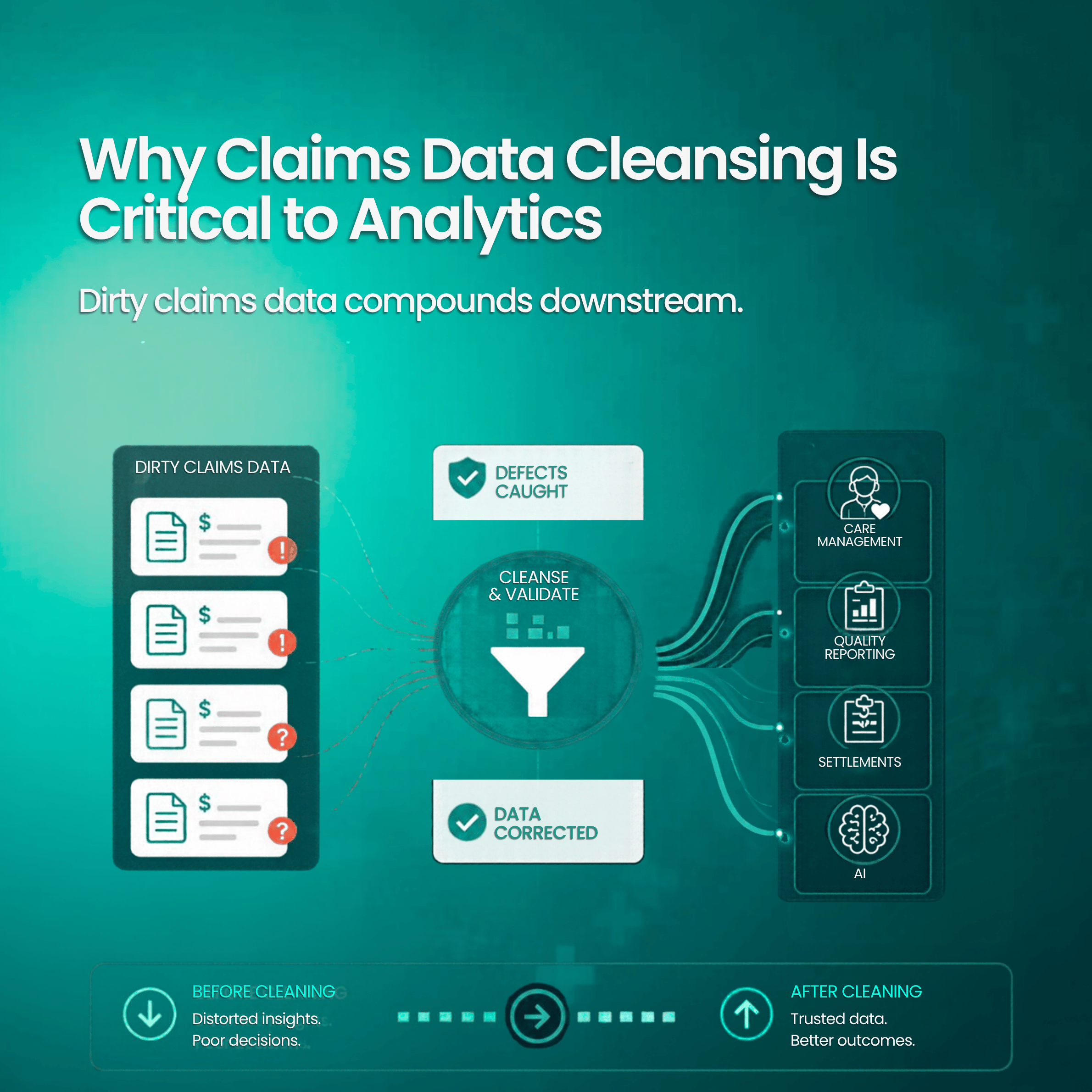
Claims data cleansing protects analytics by identifying and correcting defects before they distort care, quality, financial, and AI decisions. Bad data rarely announces itself. A payer file loads without an error, the dashboard refreshes on schedule, and the numbers look plausible. The problem surfaces weeks or months later, when a care manager calls a patient to recommend care the patient already received from another provider, when a quality measure falls short for no clinical reason, or when contract performance misses the forecast your finance team built.
Bad data does not stay in the data layer. It moves into care management, quality reporting, contract monitoring, and AI. Each step downstream makes it more expensive to find and fix. Claims data cleansing is one part of External Data Management, which transforms disparate data from payers and other outside sources into a single source of truth and keeps it current for every system and team that depends on it.
How does bad claims data affect value-based care analytics?
Bad claims data distorts value-based care analytics by changing the per member per month (PMPM) costs, member months, risk scores, and quality measures that drive forecasts, outreach priorities, and contract performance. An inflated PMPM cost can skew how performance compares with the benchmark. Members missing from eligibility files shrink the attributed population used for measurement. A risk score built on incomplete diagnoses can make a population look healthier than it is, so forecasts undercount the cost of care your teams will manage.
Once a flawed number reaches a board report, a settlement review, or a care management workflow, correcting it means unwinding decisions, not just rows. AI raises the stakes further. A model that learns from duplicated claims or misaligned members can treat those defects as patterns and repeat them at scale.
There is an analytics ROI cost as well. When the team that consumes the data has to track down data issues, your analysts spend their time reconciling payer files instead of finding and acting on insights that improve results.
What are the steps in claims data cleansing?
Claims data cleansing follows a series of steps: You must acquire, transform, resolve, and deliver the data. Validation runs throughout all the steps. Most data pipelines confirm that a file loaded; fewer check whether its contents are reliable. Integration and validation serve different purposes, and cleansing helps close that gap.
Step 1: Acquire the data from multiple incoming data sources
Acquire tracks expected files by source and cadence, confirms each arrives on time, in the right location, with the expected name, format, and population, and assesses member counts, dollars, claim volume by type and service month, and field completeness. Compares results with prior periods. When volume, values, or completeness shift unexpectedly, experts determine whether the cause is a real change, a data quality problem, or a data transfer issue. Missing, duplicate, or overdue files and unresolved shifts can skew PMPM denominators and trend lines.
Step 2: Transform claims, eligibility, and other healthcare data files
Transform maps each data file into the HDI Core Data Model and validates required fields, code values, and dates. Confirms that member IDs, provider identifiers, diagnoses, and procedure codes are present and valid for the service date. Missing or invalid diagnoses can lower risk scores by dropping conditions. Missing procedure codes can also misrepresent completed care in quality metrics.
Standardizes codes, values, fields, and formats across sources. Payers often define claim types, service locations, gender, and date formats differently, despite nominal standards. Standardizing makes cross-payer comparisons possible and supports a complete view of total cost of care.
Removes duplicates and reconciles claims adjustments and reversals. Payers often send originals, adjustments, and reversals out of order, and payer-specific rules determine the final version. One encounter can arrive as an original claim, a reversal, and a replacement. Counting the original and the replacement while ignoring the reversal counts the encounter twice and inflates cost. Keeping only the first version misses the corrected amount. Reconciling claims against history produces the final adjudicated claim, so utilization, PMPM, and high-cost member lists reflect the appropriate dollars and activity.
Aligns eligibility and member identity. Each claim needs to match an eligible member for the correct month. Different IDs across plans, products, or time should resolve to one person. Proper alignment protects member-month counts and attribution. It also preserves the longitudinal history care teams use to close gaps.
Step 3: Resolve data issues prior to loading data
Resolves each issue with its source. Monthly local patches are temporary workarounds, and defects can return. Durable healthcare data cleansing traces problems to their origin. Common causes include payer layout changes and extract errors. Documents the root cause, shares it with the source, processes corrected data, reconciles the results, and validates the updates. An upstream fix helps preserve trend continuity and confidence in each refresh.
Step 4: Deliver a single source of truth for downstream targets
Delivers clean, standardized, and validated data in the format each downstream system requires. Applies target-specific structures, value sets, and file formats for data warehouses, analytics, AI, and delegated entities. Before loading, teams should know the file’s population, dollars, completeness, and validation results. This record strengthens auditability and gives you and your payer partners a shared starting point when reported numbers differ.
None of this is a one-time project. Payers change file structures, code usage, and business logic, sometimes with little or no notice, so cleansing has to run with every file, every cycle.
Should health systems outsource claims data cleansing?
Health systems often outsource claims data cleansing when payer files take analyst time away from analysis or when file volume outgrows internal capacity. A partner can run recurring quality checks and report results before data loads; organizations building ingestion as a core internal capability may choose to manage the work themselves. For evaluation criteria, see how to choose the right claims data vendor.
HDI pioneered External Data Management for healthcare. The HDI Data Management Model continuously acquires, transforms, resolves, and delivers trusted healthcare data, with Calibrate setting expectations before processing. Clients receive cleansed, standardized claims data without handling raw payer files.
HDI applies 300+ business rules, validations, and operational checks to each file in the HDI Core Data Model. They range from the simple, such as whether fields are populated as expected and standard codes are valid, to the complex, such as reconciling claims so dollars and utilization are reliably represented. When an issue arises, the system automatically initiates an expert review.
HDI healthcare data experts investigate the root cause of each issue. When the data requires correction, they provide detailed documentation and examples for your team to share with the source to support resolution. HDI then processes the corrected data, reconciles the results, and validates the updates.
The Deliver step closes the loop with a comprehensive Data Quality Report, more than just a control file. It summarizes population and dollars, field-level completeness, and validation statistics, so your team knows what is in the data before loading it.
The HDI Advantage
The HDI Advantage combines purpose-built technology, proven processes, and hands-on healthcare data experts as one integrated capability. Rules surface exceptions, experts apply judgment, and documented processes make the fix repeatable.
One health system data services manager described HDI as “like our watchdog on the side,” one that raises issues first: payer files that never arrived, a sudden 20% drop in enrollment, or a field missing from a feed. The result is a Single Source of Truth that downstream systems and teams can rely on.
Cleanse upstream, decide with confidence
Upstream cleansing helps teams find defects before the data reaches production. Claims data cleansing at the source pays off across the organization. Analysts get their time back. Your value-based care team gets reliable numbers to monitor performance throughout the contract term. And your AI initiatives gain a foundation worth building on.
One analytics leader put it simply, explaining why HDI does the data analysis and reporting up front, before anything goes into production:
“The sooner you find the problem, the cheaper it is.”
Portfolio Manager for Analytics, Large Academic Health System, Southeast
Trusted Healthcare Data. Confident Decisions.
Frequently Asked Questions
The answers below define claims data cleansing and show why quality checks need to continue with every data cycle.
What is claims data cleansing?
Claims data cleansing is the process of finding and correcting errors in claims and eligibility data before teams use it for analytics, reporting, or AI. It includes checking each delivery, validating fields and codes, standardizing data across payers, putting originals, adjustments, and reversals in order, aligning member identity, and resolving root causes with the data source.
What is External Data Management?
External Data Management is the ongoing work of bringing payer and third-party healthcare data, including external claims data, into one consistent, current source for analytics, reporting, AI, and operations.
Why does claims data need ongoing cleansing instead of a one-time cleanup?
Claims data needs ongoing cleansing because payer file layouts, code usage, and business logic change, often with little or no notice. Claims also change after initial processing through reversals and adjustments. A one-time cleanup fixes a snapshot, while cleansing each file and cycle helps keep trends continuous and reliable over time.
How does bad claims data affect care gaps and HEDIS measures?
Bad claims data can distort care gaps and HEDIS results when claims are missing or carry invalid procedure or diagnosis codes. Duplicates and unreconciled claims adjustments can inflate PMPM and utilization, while eligibility gaps can shrink attributed populations and skew member months. The impact depends on each measure’s specifications and accepted data sources, so teams should validate claims data against the applicable requirements before reporting.