
Category: Blog
Category: Blog
Topics:
Topics:
How to Choose the Right Claims Data Vendor for Your Organization
Most health systems have strong analytics capabilities, but managing claims data from multiple payers can be challenging. The data arriving from multiple payers is messy, inconsistent, delayed, and constantly changing. Before the health system can support value-based care, AI, risk adjustment, quality measurement, or financial forecasting, they may benefit from working with a specialized claims data vendor to make that data usable and keep it that way.
The term claims data vendor spans a spectrum of capabilities, from large-scale claims data providers to integration partners that operationalize payer feeds. Experienced buyers know the difference isn’t semantic; it defines whether you’re purchasing a static dataset or building a living data pipeline. Clarity on vendor type is essential to align expectations, resources, and outcomes.
The two core types of claims data vendors
Within the claims data space, vendor type defines the relationship you’re building. Claims data providers enable scale and comparative insight through large, deidentified datasets for market intelligence and benchmarking experiences. Claims data integration partners provide precision and trust by operationalizing payer feeds into validated, analytics-ready pipelines. Both are essential, but they serve fundamentally different purposes. The right choice depends on whether your organization needs visibility across the market or reliability within your own systems.
This article focuses on claims data integration vendors. These companies take external healthcare data from payers and other sources. Then, they handle the ongoing work of ingesting, standardizing, validating, reconciling, and delivering it so your internal systems and teams can rely on it. Buying a dataset is very different from operating a trusted claims data pipeline. Each need should be evaluated by its own criteria.
The claims data vendor landscape
Within claims data aggregation and integration, most vendors fall into a few recognizable types.
Generalist data integration and ETL providers. These tools are built to move data from many types of sources into many types of systems. While that flexibility can be useful for certain data exchange needs, it usually comes with an important limitation. Generalist tools do not come with a built-in understanding of payer file formats, healthcare coding conventions, claims adjudication logic, or the business rules that make claims data usable for value-based care measurement. Their primary job is to map data from one structure to another, not to interpret what the claims are saying or catch the anomalies that are common in payer data. As a result, your team often has to build and maintain each payer connection, mapping, and validation rule on its own. When a payer changes a format, that work has to be revisited again.
Analytics platforms with built-in ingestion. Many value-based care and population health platforms include a data ingestion layer as part of their broader analytics offering. This works well when the goal is analysis within that specific platform. It is less suited to organizations that need the same trusted dataset delivered consistently across multiple systems: a data warehouse, an AI platform, an EHR, and an analytics tool all at once. Ingestion here is usually optimized for one destination, not for external data management as an ongoing, organization-wide capability.
AI “upload your data” platforms. A newer category promises insights in days with no implementation or engineering required. Simply upload your files and query them via a natural-language interface. This framing leaves out the assumption that the uploaded data is already complete, reconciled, and accurate. Most external healthcare data is not. These tools can produce confident answers even when the underlying data is wrong. It means the burden falls on your team to catch incomplete claims, unresolved member identities, and layout changes. Too often, those issues are found only after the fact.
Specialized claims data vendors. A smaller group of vendors builds specifically around the operational complexity of external healthcare data: payer format variability, claims lifecycle changes, identity resolution, and ongoing reconciliation. This is where organizations that need payer data aggregation and integration done as a genuine, continuously managed capability, not a one-time project, should be looking.
What differentiates a specialized claims data vendor
The difference between a generalist integration provider and a specialized claims data vendor is not a matter of degree. It shows up in specific, technical ways that a general-purpose ETL tool or a client-configured platform is not built to handle.
Payer format variability. Every payer delivers claims and eligibility data differently. Specialized vendors rely on accumulated knowledge of payer formats. Rather than treating each layout as a one-off mapping exercise, they already know what to look for.
Claims lifecycle complexity. Specialized vendors manage the claims lifecycle continuously because claims can be adjusted, reversed, or resubmitted long after the original date of service.
Identity management. Member and provider identities rarely line up cleanly across payers, types of services, and time. Specialized vendors apply healthcare-specific logic rather than generic matching alone to identify and match members to a unique member identifier.
Business rules and validation depth. Instead of simply confirming that a file loaded, specialized vendors apply healthcare-specific validations and investigate exceptions when the data does not make sense.
Anomaly detection over time. Specialized vendors understand that claims data must do more than load successfully; it has to make sense over time, and their experts can detect anomalies, explain what is driving them, and work with health systems to resolve what needs to change.
It’s not just claims: The full scope of payer data
Claims data aggregation and integration is often discussed as if medical claims were the only data type involved. In practice, the organizations getting the most value from external data management are integrating a much broader set of payer data, including:
- Medical claims
- Pharmacy (Rx) claims
- Eligibility
- Attribution
- Laboratory
- Biometric
- Care gaps
- Risk
- Provider
- Health Risk Assessments (HRA)
- Electronic Medical Records (EMR/EHR)
Each of these sources carries its own format quirks, update cadence, and business rules. If the data arrives incomplete or misaligned with the rest, it can distort value-based care contract performance measurement, a quality measure, or an AI model. This requires understanding a vendor’s experience. Even some specialized claims vendors may not be well-versed across data sources.
What to look for when evaluating a claims data vendor
A few questions consistently separate vendors that manage external healthcare data well from those that do not.
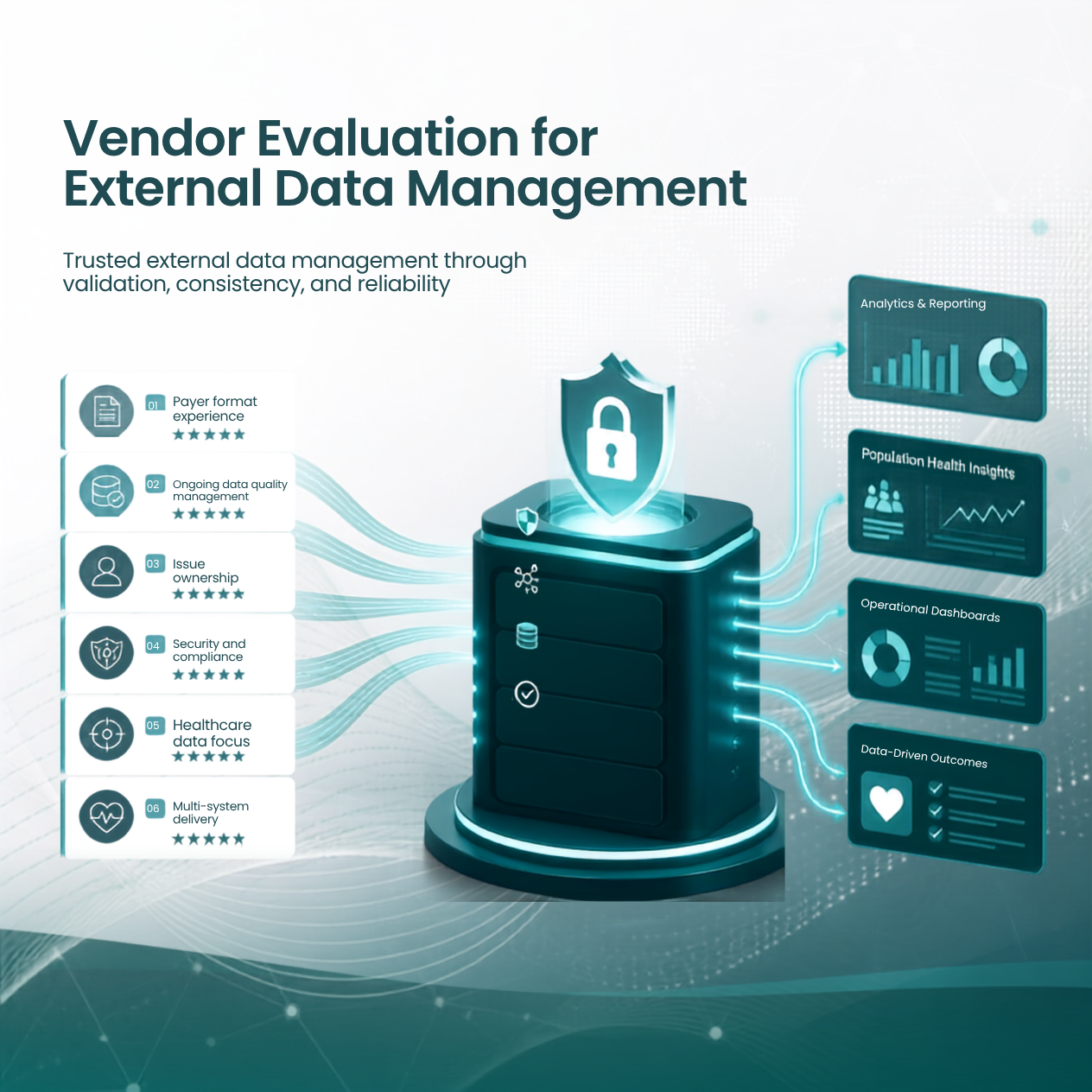
Payer format experience. Look for a vendor with proven experience managing many payer layouts, including how they detect and respond when formats change.
Ongoing data quality management. Confirm whether the vendor can monitor claims, eligibility, and related data as it changes, identify anomalies, explain what is driving them, and help resolve issues rather than simply ingesting files.
Issue ownership. Ask who investigates, documents, and confirms the fix when data problems are found.
Multi-system delivery. Determine whether the vendor can deliver one trusted dataset consistently across an EHR, data warehouse, AI platform, and analytics tools.
Security and compliance. Verify baseline requirements such as current healthcare security certifications and a clear operating model for handling protected health information.
Healthcare data focus. Prioritize vendors with long-standing, healthcare-specific claims data experience, not general integration experience applied to healthcare as one of many verticals.
Why this decision is worth getting right
External Data Management, the ongoing work of acquiring, standardizing, and delivering trusted external healthcare data, is not a one-time implementation. It is a continuous operational discipline that either strengthens or undermines everything built on top of it.
When the vendor model is wrong, the consequences show up everywhere downstream. Quality teams lose confidence in the results. Finance teams question forecasts and contract performance. Data teams spend time chasing file issues instead of building usable analytics. AI and automation efforts inherit the same gaps, delays, and inconsistencies already present in the source data.
HDI built its business around this distinction. For more than 16 years, HDI has focused exclusively on healthcare data, managing data from 627+ healthcare data vendors across 2,600+ vendor layouts, applying 300+ business rules and validations, with an average of 7+ years of member history maintained per source. HDI’s specialization is reflected in its operations.
As one HDI client described the direct impact of specialized expertise: “HDI has always understood the overall ecosystem of healthcare claims the best.”
Whichever vendor an organization ultimately chooses, the evaluation should start with a clear view of what claims data aggregation and integration actually require. Everything else relies on getting that foundation right.
Trusted Healthcare Data Enables Confident Decisions.
About Health Data Innovations
Health Data Innovations (HDI) transforms disparate external healthcare data into a single source of truth and keeps it current for every system and team that depends on it. HDI has combined purpose-built technology, proven processes, and hands-on healthcare data experts to continuously acquire, transform, resolve, and deliver trusted healthcare data. Today, organizations rely on HDI to reduce the burden of managing complex external healthcare data so their teams can focus on analytics, AI, value-based care, financial performance, and other strategic priorities.