
Category: Blog
Category: Blog
Topics:
Topics:
What Healthcare Data Is Needed for Value-Based Care Contracts
Value-based care contracts depend on data that health systems and their payer partners share. Payers attribute members, total the cost of their care, score quality, and calculate a settlement. This often happens months after the performance year closes. When both sides work from the same data, the health system can confirm the result, resolve differences, and plan with confidence.
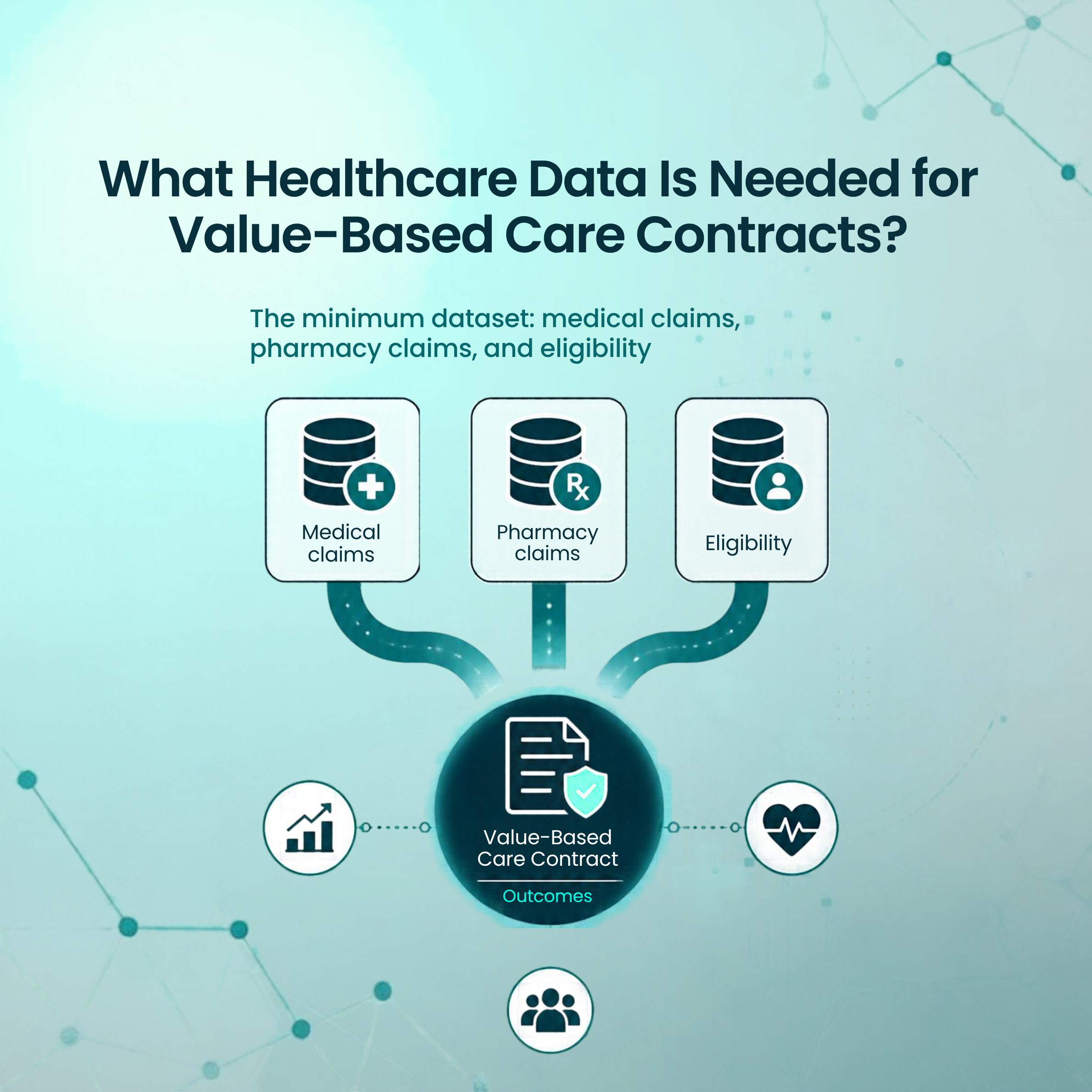
Each value-based care contract starts with a minimum dataset from each payer: medical claims, pharmacy claims, and eligibility. Payers use these files to calculate total cost of care, utilization, attribution, and settlement. Other data can add precision, depending on the contract. These sources include attribution files, care gap reports, risk scores, and lab results. Some quality measures also use clinical data.
The minimum dataset: medical claims, pharmacy claims, and eligibility
Every value-based care analysis rests on a minimum of three payer files.
Medical claims
Medical claims record the professional and institutional services billed for each member. They include diagnosis and procedure codes, revenue codes, place of service, rendering provider, and allowed and paid amounts. Payers send adjustments and reversals after the original claim. These changes must be reconciled to final action claims before dollars and utilization are reliable.
Claims history keeps changing long after the date of service. As John Supra explains:
“If I get a claims file today based on prior claims, there is a whole collection of changes that happened in that history, and for some of these relationships, up to 12, 18, 24 months later.” – John Supra, Founder and Managing Member, Better Health Matters
Pharmacy claims
Pharmacy claims capture drug codes, fill dates, days supply, quantities, and paid amounts. The spend makes up a meaningful share of total cost of care. Quality measures such as medication adherence also depend on fill history that most clinical systems do not have.
Eligibility
Eligibility data defines which members have coverage, under which product, and for which months. It establishes quality measure calculations and supports attribution.
Other data that adds precision
Depending on the contract, other types of data sharpen the picture.
- Attribution: The members you are accountable for under each contract, and for which months. Risk pool membership can change monthly, and every downstream measure, from cost to quality to provider compensation, depends on getting that population right.
- Care gaps: Identifies which quality measures remain open, and for which members.
- Risk scores: Determines how payers measure the health status of your population, which can adjust benchmarks and payments.
- Lab results: Clinical values, such as HbA1c, that some quality measures use.
How payers turn this data into settlement
Methods vary by contract, but the pattern is similar.
Total cost of care. Typically, payers calculate total cost of care from medical and pharmacy claims for attributed members, divide it by eligibility member months, and compare it with a benchmark. Shared savings or losses follow from the difference.
Quality. Payers score quality performance against percentile thresholds. When a tier depends on how many patients meet a measure, a handful of patients can determine which tier, and which payment, applies.
“There was one instance in a previous org where a care coordinator was able to chase down just a few more patients, and that got us to the 90th percentile benchmark, and that made the difference of nearly $1 million in incremental revenue on that particular value-based care contract.” – Chris Ragsdale, Founder and Principal, Towers Advisory
Settlement. After the performance period ends, payers bring cost, quality, and attribution together in the settlement. A health system with a validated copy of the same claims and eligibility data can follow and optimize performance during the year, and work through differences with its payer partners.
What makes payer files reliable
Each payer sends files in its own layouts, on its own schedule, with its own field definitions, and they sometimes change without notice.
“Even within the context of standards, there are no standards.” – Jonathan Kaye, Founder and Executive Chairman, Health Data Innovations
Making those files reliable takes ongoing work. Teams must receive every expected file from each payer, normalize and standardize layouts and definitions, and validate each file for completeness and consistency. They also resolve issues with the source, tie the data together, and format it for downstream systems. The health system then integrates the data in its own environment.
We have written in more depth about why integrated claims data can still put value-based care at risk, how claims data shows care beyond your own walls, and why AI amplifies the gaps in the data beneath it.
Questions to ask about your healthcare data
- Can we follow each contract’s settlement calculation using our own data?
- Do our member months and attributed populations reconcile to what each payer reports?
- Do we know when an expected file is missing, late, or incomplete before it reaches reporting?
- How do we track adjustments and reversals to historical claims?
- When numbers don’t match, who works with the payer to find the root cause and confirm the correction?
Without that view, settlement becomes the first complete picture of the year, and it arrives after the performance period – when no one can change the result.
Where External Data Management fits
HDI calls this ongoing claims data work External Data Management: tracking every expected file, normalizing and validating payer data, verifying completeness, investigating the root cause of each issue, and confirming its resolution with from the source. Payer files, layouts, contracts, and historical claims keep changing, so the work continues for the life of every contract. Done well, every system that uses the data works from the same validated source of truth.
“I don’t think any of us realized how frequently we had missed files from the payers until we started interacting with HDI.” – HDI client
About HDI: Health Data Innovations has focused exclusively on healthcare data for more than 16 years, with experience across more than 627 data vendors and supports data covering 28M lives.
See where your claims data stands. Take the External Data Management Assessment.
Trusted Healthcare Data. Confident Decisions.