
Category: Blog
Category: Blog
Topics:
Topics:
As Margins Tighten, Is Claims Data Readiness Slowing AI for Health Systems?
Data readiness can slow AI in health systems before implementation even begins. When leaders aren’t confident that external payer claims are complete, consistent, and matched to the right members, they hesitate to move AI projects forward. Once a tool goes live, unreliable data creates a second slowdown: teams spend time chasing down results that don’t look right, and tight margins make that rework harder to manage. Preparing claims data before an AI tool uses it is one practical readiness step, and External Data Management is the ongoing work that gets that data ready for downstream use.
Separate reports from The Health Management Academy, KLAS Research, and HIMSS point to three pressures converging at once: thin margins, growing AI investment, and limited confidence in data. Health systems trying to do more with less are assessing AI to streamline work across the organization, yet AI depends on quality data. The financial pressure behind that push explains why readiness matters now.
What financial pressures are health systems facing in 2026?
Financial pressure is changing day-to-day operations. Federal funding is less predictable, costs are rising, and reimbursement is shifting. Many organizations are reviewing budgets and postponing lower priority spending.
In 4 Forces Compressing Hospital Profit Margins in 2026, The Health Management Academy reports that the median operating margin for U.S. health systems fell to 0.4% year to date as of March 2026, down from 1.6% in 2024. In 2025, workforce costs rose 5.6%, supply costs 9.9%, and drug costs 13.6%. The same analysis cites American Hospital Association data showing Medicare paid hospitals 83 cents for each dollar of cost in 2024.
Federal policy adds to the strain. Becker’s Hospital Review reports that the One Big Beautiful Bill Act reduces Medicaid spending by more than $911 billion over 10 years. Becker’s also describes how health system leaders are connecting difficult business decisions to federal funding changes.
How are health systems changing the way they buy technology?
Health systems are buying solutions to specific problems rather than technology for its own sake. In The Health Management Academy’s research, technology leaders say they want tools that fit existing workflows, transparent pricing, vendors who take time to understand how their organizations work, and support that continues after go-live. As one leader put it: “We don’t buy tech, we buy solutions.”
With less room for trial projects, leaders are wary of AI pilots that don’t reach production. As one health system leader said during a recent Becker’s Healthcare webinar panel, the experience can feel like “death by pilots”: projects that absorb time but fail to deliver results. That pattern is one of several healthcare technology trends for 2026 shaping how leaders invest.
How is AI reshaping healthcare IT priorities?
AI was the one healthcare IT investment priority that increased substantially in KLAS Research’s 2026 global healthcare IT trends research. The research includes markets outside the U.S., so it describes broader trends rather than measuring U.S. health systems alone.
KLAS Research notes that many organizations are still deciding how to deploy AI, prepare their systems, and govern new tools as staff begin using them. Leaders are asking what they can do now to prepare for AI and automation.
What is holding health systems back from implementing AI with confidence?
Data quality is one part of a broader readiness gap that includes regulatory resources, cybersecurity, and workforce capacity. HIMSS’s 2026 AI Landscape Report finds that 47% of organizations are confident their data is accurate, and about half feel equipped to manage regulatory requirements.
When leaders are unsure whether data is ready, they may delay projects that could help close care gaps, manage chronic disease, or support clinical teams. With the right preparation, data does not have to remain a barrier.
Where can AI help health systems do more with less?
Population health is a clear opportunity for AI. These tools can help care teams find people who need attention sooner and reduce manual work. HIMSS reports that three in four organizations plan to use AI to advance patient-centered care, with identifying care gaps and supporting chronic disease management among the top use cases.
Claims data can help show care delivered outside the health system, though it arrives on payer timelines, so teams should consider it alongside clinical and eligibility data. Human review gives teams a chance to check AI output before acting on it, and preparing claims data up front reduces time spent investigating results that look wrong.
What readiness investments can health systems make now?
The most useful readiness investments solve a specific problem instead of adding another tool. Health systems can start by inventorying the payer data they receive, who manages each feed, and where teams spend time preparing or checking it. Claims data management often requires specialized data and integration skills, and claims data ingestion is harder than it looks because each payer sends files in its own format.
What makes claims data ready for AI?
Claims data is ready for AI when teams know that expected files arrived, validation checks are complete, someone has reconciled the records, and claims match the right member. Teams also need consistent structures and terminology before they use the data in analytics or AI.
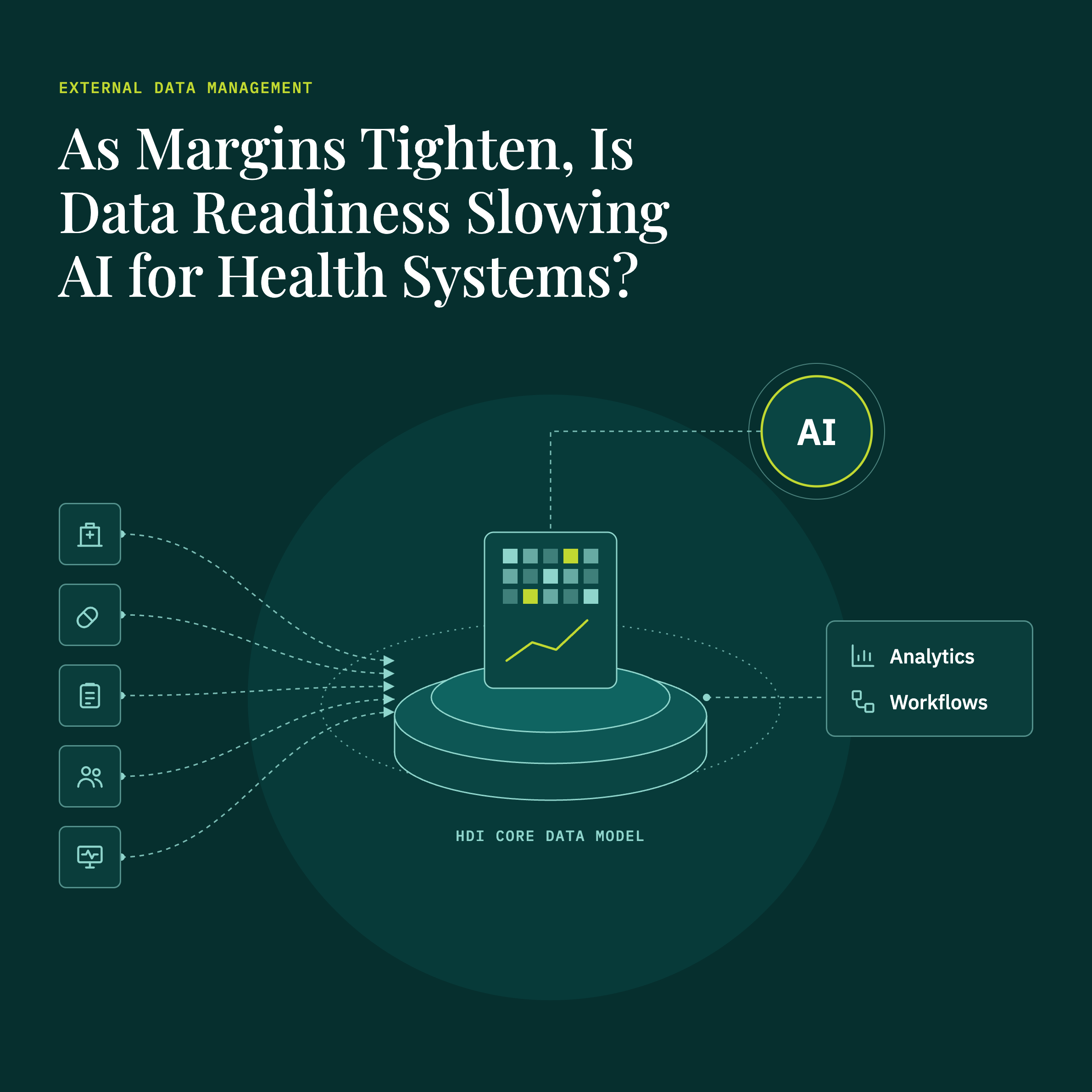
KLAS Research notes that AI cannot make up for a database that lacks structure and normalization. External Data Management prepares payer data by acquiring, validating, standardizing, resolving, and delivering it for use in downstream systems.
This comparison shows how AI-ready claims data differs from claims loaded without rigorous validation:
Area
Claims loaded without rigorous validation
AI-ready claims data
Completeness
Teams assume each payer file arrived in full, so gaps can go undetected and AI can work from an incomplete picture.
Validation checks confirm expected files arrived, flag missing data, and check that data meets business rules.
Structure
Each payer uses its own layout, and payers can change a layout without warning. The file may still load without errors, yet the data inside it is no longer reliable.
Standardization gives files a common structure so they load consistently.
Codes and terminology
Codes and descriptions vary by payer, so the same service can look different from one source to the next and skew results.
Normalized codes and descriptions make the data more consistent across sources.
Member match
Member IDs may vary across vendor files. If a member identifier is off, claims can attach to other family members on the same policy.
Consistent member identifiers and eligibility data help connect claims to the right member.
Issues
Teams find problems after reports or models run, which leads to rework and decisions based on bad data.
Teams document issues, route them for correction, and validate corrected data before downstream use.
Loading data into a warehouse does not confirm that the data is validated or reconciled, and integrated data is not the same as validated data.
How does reliable claims data support value-based care?
Claims data can help health systems monitor risk, care gaps, and care management throughout a value-based care contract. It can show patterns in care delivered outside the organization, and teams should interpret it alongside clinical and operational data. Health systems that put claims data to work this way may find opportunities they had been missing.
Where should health systems start?
Health systems can start by mapping the external payer data they already receive and how well it holds up in daily use. Whether a health system has already implemented AI or is still considering it, now is the time to invest in claims data as a strategic asset that maximizes the performance of AI initiatives. A few practical steps help leaders see where preparation will matter most:
- Inventory each payer feed: List the payers, file types, and delivery schedules, and note who manages each feed today.
- Measure the effort: Track how much time analysts and engineers spend loading, checking, and correcting claims data each month.
- Ask where trust breaks down: Talk with the teams who use the data about where they double-check reports or work around known issues.
- Trace one AI use case: Pick a priority use case, such as identifying care gaps, and map which data it needs and where that data falls short.
- Weigh the options for preparing the data: Compare managing the work internally, using an analytics platform, and working with a specialist partner.
Those answers give leaders a clear picture of the groundwork AI will need and where to invest first.
Health Data Innovations (HDI) helps health systems prepare external payer data for AI and value-based care. HDI has worked with 627+ data vendors, supports claims data for more than 28 million lives, and brings more than 16 years of experience in healthcare data management.
Watch the webinar: What External Payer Data Demands for Value-Based Care and AI
Frequently asked questions
What is External Data Management?
External Data Management is the ongoing work of acquiring, validating, standardizing, reconciling, and preparing data from outside a health system so teams can use it in downstream systems.
Why is claims data a bottleneck for AI?
Each payer sends claims files in its own layouts and codes. Original claims, adjustments, and reversals can change claims that teams loaded earlier, sometimes after long gaps. Teams need to validate and reconcile the data before they can rely on it in analytics or AI.
What is the difference between integrated and validated claims data?
Integrated claims data has loaded into a system, links medical and pharmacy claims to the same member, and connects with clinical data in the EHR and workflow tools. Validated claims data has passed checks for completeness, structure, and business rules. Claims data can integrate without passing validation, which is why loaded data can still produce unreliable results.