
Category: Blog
Category: Blog
Topics:
Topics:
9 Healthcare Technology Trends for Health Systems: AI, Data, and Interoperability Insights from Becker’s 2026
Healthcare technology trends in 2026 reflect a shift in how health systems are approaching data, artificial intelligence, and digital care. Across sessions at Becker’s Health Information Technology + Revenue Cycle Conference 2026, healthcare leaders described significant progress exchanging data, expanding digital care, and putting AI to work. But much of the discussion focused on what comes next:
- Moving data does not necessarily make it usable.
- A successful artificial intelligence (AI) application can save time without saving money.
- A technology can work as designed and still create new work elsewhere.
- And implementing a new system can require changes to data, clinical workflows, staffing, and financial operations long after the technology goes live
Key healthcare technology trends from Becker’s 2026
The discussions point to several trends in how health systems are approaching technology:
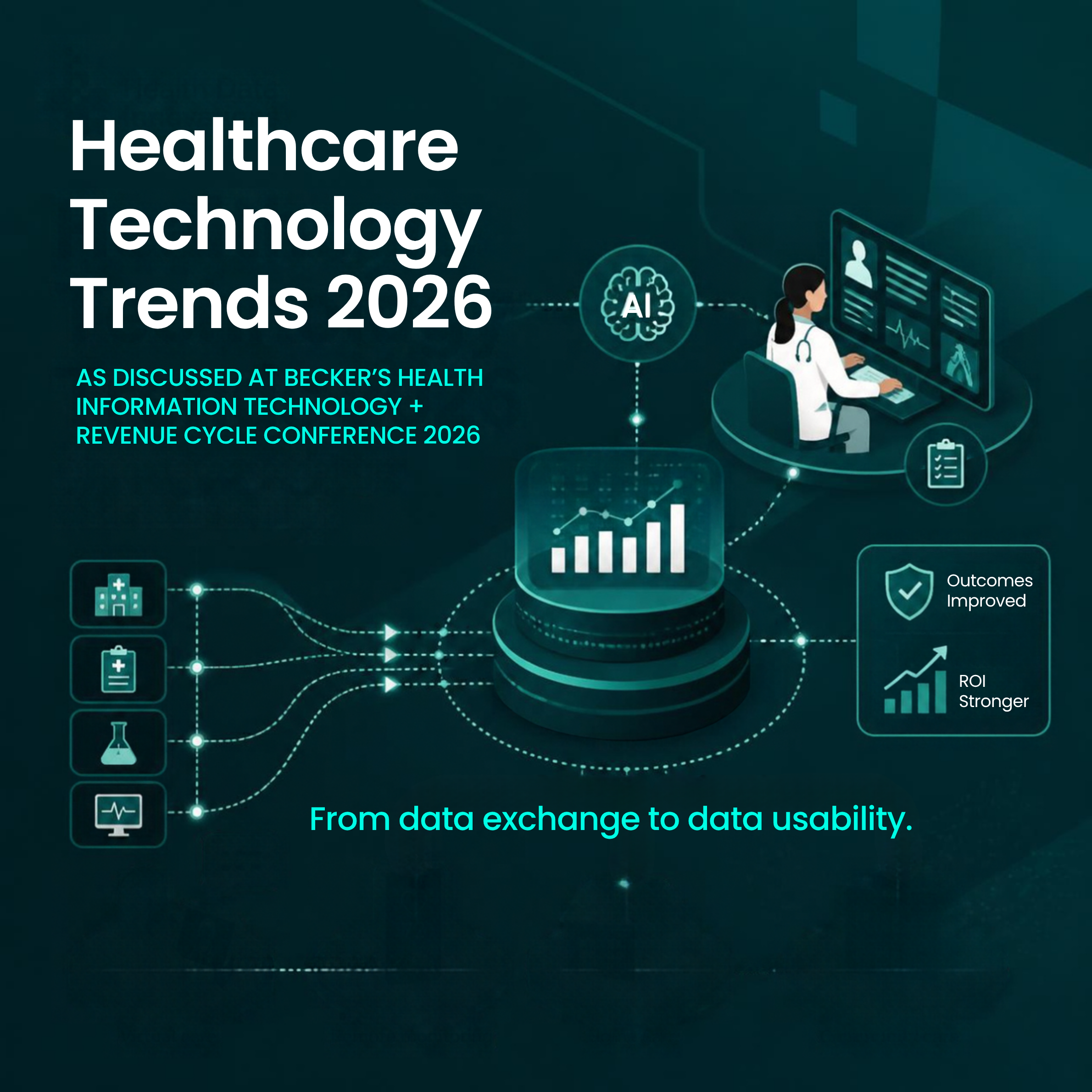
- Interoperability is moving from a data-exchange problem toward a data-usability problem.
- AI is moving into specific clinical and operational workflows.
- Organizations are applying more scrutiny to technology investments and their results.
- Digital tools are changing how and where care takes place.
1. Healthcare interoperability is moving from data exchange to data usability
Healthcare has become much better at moving data between organizations. The interoperability panel pointed to the scale of the Trusted Exchange Framework and Common Agreement (TEFCA) as one indication of that progress. In June 2026, the U.S. Department of Health and Human Services reported that more than 1 billion health records had been exchanged through TEFCA.
But the panelists made a distinction between “successfully transferring healthcare data and making that data usable, trusted, and actionable after it arrives,” as asked by the moderator.
One speaker identified data quality and missing context as major challenges, using an IKEA analogy. Imagine receiving a box containing all the parts, but none are labeled, and the instruction manual is missing. The delivery worked. The recipient still must determine what the pieces are and how they fit together.
“We receive this data, but the context is missing. We have gotten very good at moving the box, and packing it, and moving it,” she said. “The challenge here is opening it, and understanding it, and assembling it. It does take many cycles for us to assemble it.
“And that is where I think the trust and usability comes in… Because now that we have more and more AI coming out, it becomes even more important for us to help create that governed data.”
Her point was about context. The receiving organization may interpret incoming data differently from the organization that sent it. Making the data usable can require substantial work after the transfer itself.
The panel described other challenges that remain after data moves. Patient identification was one of the issues highlighted. One speaker recalled an organization with more than 200 patients who shared the same name. Resolving those identities required additional technology, process improvements, and, in some cases, staff involvement.
Another problem was relevance. Clinicians can receive lengthy clinical documents containing more information than they need for the immediate problem they are treating. The issue is not simply whether the record arrived, but whether the clinician can find the information that matters.
And data exchange does not necessarily complete the underlying care process. A patient moving to a nursing home or rehabilitation facility may still require a phone call and human coordination, even when clinical information is transferred electronically.
The discussion suggests that interoperability is entering a more difficult stage. Moving information remains necessary, but the value increasingly depends on identity resolution, data quality, consistent meaning, context, and the ability to put the information to use.
2. Better healthcare data does not eliminate the need for human interpretation
A separate discussion about physician-led quality improvement approached the data problem from another direction.
One organization brought analytics, performance improvement, and operational teams together to evaluate results. They did not look at performance measures in isolation. They considered regional differences, referral patterns, patient choices, and local practices.
When physicians challenged a measure, the response was not to assume either the data or the physician was wrong. The team investigated the concern, determined whether it was legitimate, and worked with clinicians to identify what they could influence.
The discussion showed the limits of treating a dashboard as the answer. Analytics can identify results or patterns. People who understand the clinical and operational environment still must interpret why it occurred and determine what to do about it.
That same pattern appeared elsewhere at the conference. Technology increasingly helps healthcare organizations find, organize, and analyze information. Human judgment remains important when the meaning of that information depends on the patient, clinical situation, or operating environment.
3. Healthcare AI is moving from pilots into specific workflows
The AI discussions suggested that some health systems are moving away from experimenting with AI for its own sake, some even calling this activity “death by pilots.”
One care operations leader described the problem as having plenty of pilots but relatively few that meaningfully reached the patient experience. The organization instead focused on the “vital few versus the trivial many.”
The starting question was not what AI could do. It was where patients encountered friction and whether technology could remove it.
An AI care companion illustrated the approach. The speaker asked the audience to consider a patient recovering from hip or knee surgery who has a question late in the evening, when reaching a nurse may be difficult. The organization introduced a 24-hour AI care companion to answer those questions.
After several months, about 40% of the conversations were occurring outside traditional hours.
The speaker’s takeaway was not about the technology. It was about reach: Could the organization meet a patient’s needs when the patient needed help?
Other examples also addressed defined tasks. Health systems described AI-generated preliminary responses to patient messages that clinicians review before sending, tools that help patients navigate services, automated support for administrative work, and systems that help employees search large collections of internal documents.
Clinical examples included software that reviews chest computed tomography (CT) scans and alerts a cardiac surgeon to a possible aortic dissection before the radiologist has reviewed the exam. The surgeon then reviews the scan and helps determine what should happen next.
Other discussions included retinal image analysis for patients with diabetes, tools used in stroke care, and outreach to patients who may benefit from lung cancer screening.
Across those examples, AI generally performed a specific part of a larger process. It found information, generated a draft, identified a potential issue, or extended access. People – the “human in the loop” – remained responsible for reviewing the result or deciding what to do with it.
4. AI adoption is growing, along with scrutiny of ROI and value
As AI moves into regular use, healthcare leaders are also asking harder questions about what constitutes a meaningful result.
One leader reported more than 10,000 annualized hours saved within a department through its own use of AI. The team tracked productivity and redirected the additional capacity to other work and skills development.
That example is important because the organization described the result as capacity, not an equivalent reduction in spending.
A different leader made that distinction more explicitly. An AI assistant had gained widespread use and provided clear value to the organization. Still, the leader questioned a vendor calculation that attributed millions of dollars in savings to the product.
The issue was not whether the tool helped. It was whether the financial calculation accurately represented what the organization had gained.
A lung nodule detection application exposed another dimension of value. The speaker said the technology worked as intended, but it also generated some false positives. Those results could cause patient anxiety and create additional clinical review, testing, and communication. The organization was working with thoracic surgeons to determine how clinicians should review and communicate findings before patients received them.
The speaker did not characterize the implementation as a failure. Instead, the example showed why technical performance alone does not capture the full effect of a technology.
The relevant measure may include what happens downstream: additional testing, clinician workload, patient communication, capacity created, safety improvements, and, when appropriate, financial results.
That is a higher bar than simply demonstrating that an AI application works.
5. Human oversight is evolving with healthcare AI adoption
Several sessions also challenged the assumption that broader AI adoption necessarily means removing people from the process:
- Clinicians reviewed AI-generated patient messages.
- Staff reviewed AI-drafted appeal letters.
- A surgeon reviewed imaging after receiving an automated alert.
One leader distinguished between increasing adoption and increasing autonomy. An organization can expand the number of people using AI without giving the technology greater authority to act independently.
Governance is evolving alongside those uses. One organization described an AI governance structure established about four years earlier, while another had revised its governance approach several times as its experience with the technology grew.
The discussions suggest that AI readiness increasingly includes decisions about where human review belongs. Organizations must determine which outputs require verification, who makes consequential decisions, and where responsibility remains when AI contributes to the work.
6. Digital health is becoming part of the care delivery model
The conference discussions also showed significant changes in care delivery that extend beyond AI.
Health systems described virtual specialty clinics, digital hospital rooms, remote consultations, patient navigation, and expanded screening programs.
One organization developed virtual services for specialties including menopause and weight management. In one example, a physician conducting a virtual visit determined that a patient needed imaging. The resulting scan identified a brain tumor.
The significance of the example lay in the connection among virtual access, clinical judgment, and follow-up care.
Another organization described a respiratory assessment program that included free assessments and, for some patients outside standard lung cancer screening eligibility, free CT scans and follow-up visits. The speaker reported that the program had identified six cancers since its launch the previous September.
One health system described incorporating digital technology directly into patient rooms in a new hospital facility. Rooms included digital whiteboards, cameras, interpretation capabilities, and technology that allowed specialists to consult with patients and bedside clinicians remotely. The organization was also considering camera-based fall prediction as a future capability. The example showed how health systems are using digital tools to bring services and clinical expertise directly to the bedside, rather than limiting digital care to traditional virtual visits.
Taken together, the examples show digital technology moving further into the delivery of care itself. The change is not simply that more encounters can happen virtually. Health systems are connecting virtual access, screening, specialist expertise, patient communication, and physical care settings in new ways.
7. Health systems are becoming more selective about technology
The abundance of new technology is creating another problem: deciding what deserves attention.
One technology leader compared health systems facing a flood of AI pitches with “minnows” surrounded by sharks.
The concern was the volume of proposals and the difficulty of determining which vendors could deliver on their promises, whether another product fit the organization’s strategy, and whether the benefits justified the integration, security, maintenance, and support it would require.
The frustration with endless pilots surfaced elsewhere. One speaker described this as “death by pilots.” Another emphasized the “vital few versus the trivial many.”
Those comments point to a move toward greater selectivity. Testing technology is not the objective. Organizations want to identify a meaningful patient, clinician, or operational problem first, and then determine whether technology can solve it.
The build-versus-buy discussion reached a similar conclusion from a different direction.
One leader preferred using major technology platforms when they could meet the organization’s needs, in part because each additional product adds support and integration requirements. But the speaker also questioned whether organizations should continue to accept significant functional gaps simply because they already use a specific platform.
An “80% rule” illustrated the problem. The speaker questioned accepting software that meets most requirements when the remaining gap leaves employees struggling with an important task. The example involved an on-call scheduling product that required hours of work and was unpopular with clinicians.
The 80% figure was a decision-making guideline, not an industry benchmark. The larger question was whether a specialized product or internally developed application could materially improve the work enough to justify the additional investment and support.
8. Clinician demand is changing healthcare technology adoption
While health systems are becoming more selective, demand for some technology is now coming from a different direction.
One leader said that, for the first time in a nearly 35-year career, physicians were asking for technology rather than being told they had to use it. Their requests included access to secure conversational AI and tools that could help prepare letters.
That does not eliminate the challenges of adoption. Other speakers emphasized clinical champions, observing employees at work and responding quickly when a new process does not meet their needs.
But it changes the starting point.
Technology leaders may increasingly face demand from clinicians and employees who already know what capabilities they want, while simultaneously facing an expanding market of vendors eager to provide them.
That makes disciplined selection more important. The challenge becomes matching genuine demand to a defined problem, a workable technology, and the organization’s ability to support it.
9. Healthcare M&A shows why technology integration extends beyond go-live
The merger and acquisition discussion showed what happens when technology, data, operations, and financial requirements must change simultaneously.
One health system described acquiring two distressed hospitals and moving them onto its electronic health record (EHR) system in six months. The EHR vendor had recommended an 18-month implementation.
The six-month timeline did not represent a faster standard for EHR conversions. Financial circumstances drove it. An expensive transition services agreement made a longer implementation difficult to sustain.
“Don’t do this at home,” the speaker cautioned.
The compressed timeline forced the organization to decide what absolutely had to work on the first day. The priorities were patient safety, regulatory requirements, and revenue integrity.
That meant deciding which historical data clinicians needed in the new system immediately, which information they could access through an interim arrangement, and which data the organization could migrate later. Some of the data work continued after go-live.
Other parts of the transition moved on different timelines.
Training clinicians reduced the time available for patient care and required staffing coverage. Credentialing delays could interrupt revenue. One ownership-change and provider-number process that the organization expected to take six to nine months lasted more than a year.
Clinical workflows also required judgment. The acquiring organization could not simply impose academic medical center practices on community hospitals with different services, staffing, and physician relationships.
Panelists emphasized the importance of involving local physicians and other respected leaders early enough to understand those differences. What initially appeared to be resistance could reflect legitimate knowledge about how a proposed change would affect patient care or daily operations.
A system can technically go live in six months and still have substantial integration work ahead. Go-live marks a milestone. It does not mean the data, revenue processes, workflows, and people have finished the transition.
The larger trend: Technology is advancing faster than the work around it disappears
Across the sessions, the speakers described very different technologies and problems, but several patterns emerged across sessions.
- Healthcare can move more data, but organizations still must determine what that data means and how to use it.
- AI can complete more tasks, but health systems must decide where people should review its work, what happens downstream, and how to measure the benefit.
- Digital technology can expand where care happens, but health systems still have to connect those new models to clinical care.
- And organizations can implement technology quickly, but implementation does not eliminate the data, workflow, staffing, financial, and cultural work around it.
That may be the more important trend emerging from the Becker’s discussions. Healthcare technology is becoming more capable and more widely available. The work is shifting toward making those capabilities useful in the complicated environment in which healthcare operates.
Frequently asked questions about healthcare technology trends
What are some of the major healthcare technology trends in 2026?
The discussions at Becker’s 2026 pointed to several trends: interoperability is moving beyond data exchange toward data usability; AI is being applied to specific clinical and operational workflows; health systems are scrutinizing the value and downstream effects of technology more closely; human oversight remains important as AI adoption grows; and digital tools are becoming more integrated into care delivery.
How are health systems using AI?
Health systems described using AI for defined tasks including drafting preliminary responses to patient messages, helping patients navigate services, supporting administrative work, searching internal information, analyzing medical images, supporting screening programs, and extending access to patients outside traditional hours.
Why is healthcare interoperability shifting from data exchange to data usability?
Healthcare organizations have become better at transferring information, but receiving data does not necessarily make it usable. Health systems still face challenges with data quality, missing context, patient identity, consistent interpretation, and finding information relevant to a particular clinical situation.
How are health systems measuring the value of AI?
The discussions suggested that health systems are looking beyond whether an AI application technically works. Measures of value can include capacity created, clinician workload, additional testing, patient communication, safety improvements, and financial results. Time saved does not necessarily translate directly into money saved.
What role does human oversight play in healthcare AI?
Across the examples discussed at Becker’s, AI typically performed one part of a larger process while people remained responsible for reviewing results or making decisions. Health systems are increasingly determining which AI outputs require verification, who should make consequential decisions, and where accountability remains when AI contributes to the work.