
Category: Blog
Category: Blog
Topics:
Topics:
What Is Analytically-Ready Data? A Definition Health System Leaders Can Act On
Value-based care initiatives, AI projects, and population health dashboards often rest on the assumption: the data underneath it is ready to be used. Most health systems find out that assumption is often wrong only after the numbers do not add up.
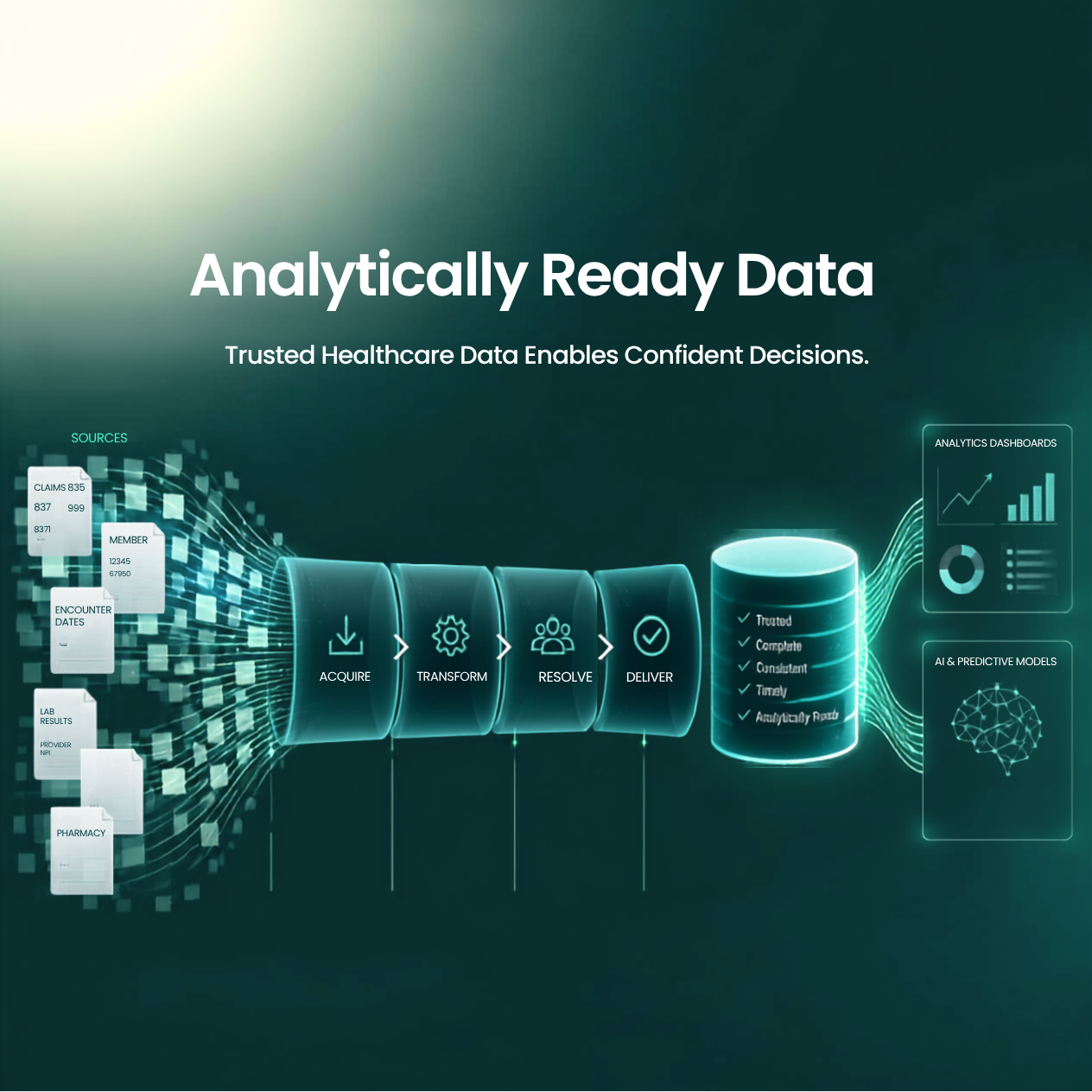
Analytically-ready data is not the same as data that has arrived. It is not the same as data that has been loaded into a warehouse or mapped to a schema. Any data, particularly external healthcare data with different formats, various vendors, and identifiers, is not analytically-ready until it has been validated, normalized, standardized, and reconciled to the point where an analyst, a data scientist, or an AI model can trust it.
For executives, that distinction determines whether analytics investments produce decisions or dashboards with potentially misleading insights. For VBC operations and performance teams, it determines how much time gets spent on improving outcomes versus investigating data issues, reconciling conflicting results, and working around unreliable workflows and reports.
What defines analytically-ready data
Three characteristics separate analytically-ready data from data that the system uses.
- Completeness. Expected files from every source and cycle have arrived. Gaps have been identified and resolved. Records are represented in the data set as expected.
- Consistency. Data from vendors, each with its own layout, coding conventions, and quirks, has been mapped into a common structure, so codes, dates, and member identifiers mean the same thing everywhere they appear.
- Validated accuracy. Fields are populated as expected. Standard codes are understood and valid. Member identity is reconciled to unique identifiers. Claims are sequenced and represented over time to ensure that dollars and utilization are represented accurately. Identified variances have been reviewed to separate data errors from genuine shifts and insights.
None of these characteristics show up by simply moving data from a payer or clearinghouse into a warehouse. Basic data integration ensures the data gets to where it needs to go. It does not necessarily ensure the data is analytically ready.
How health systems must prepare analytically-ready data
Getting external healthcare data to this standard requires ongoing discipline, not a one-time project. Vendor formats change. New sources get added. When issues are identified, payers send corrected files. Member history accumulates. Each change can introduce a new source of error, which means analytically-ready data must be maintained continuously, not set up once and left to run on its own.
This is where many health systems get stuck. Building the capability internally means hiring specialized expertise, maintaining numerous vendor layouts that are subject to change, and running business rules against every file, every cycle, indefinitely. This often requires investigation and understanding of the external data in order to resolve the issues upstream, prior to loading.
What to look for in a solution
A solution that only aggregates or integrates data solves half the problem. When evaluating an External Data Management partner, look for three things.
- A defined validation methodology. It should not be a black box. The vendor should be able to communicate how data quality checks and business rules are applied, examples of the types of checks that occur, and how exceptions get resolved. They must also account for what is in the data beyond a simple control file.
- Identification and resolution of root cause. When an anomaly appears, it is not enough to detect an issue. The partner must identify the cause and resolve the issue. If it is a data source problem, they must document the issue for correction so the payer can send a new file. Once they receive new data, it must go through the transformation process.
- A single source of truth for outputs. The solution must provide a consistent output delivered to every downstream system, so analytics, workflows, reporting, and AI are all working from the same trusted data.
How HDI builds the foundation
HDI pioneered External Data Management for healthcare because integration alone was not enough. The HDI Data Management Model continuously acquires, transforms, resolves, and delivers trusted healthcare data rather than setting up the system once and relying on that system to push the data through.
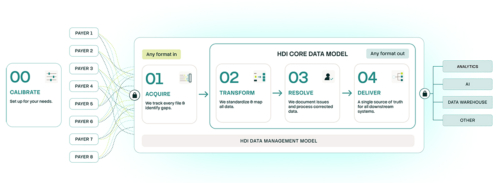
The HDI Data Management Model
- Acquire. Every expected file is tracked so missing or overdue data is caught before it becomes a downstream problem.
- Transform. Files are mapped into the HDI Core Data Model and run through a library of more than 300 data quality checks and operational business rules, from basic field validation to claims sequencing. When an issue surfaces, HDI’s hands-on healthcare data experts investigate and document the root cause.
- Resolve. Work with the client or source to resolve the problem, rather than passing an unresolved anomaly downstream.
- Deliver. The result is a Single Source of Truth – one trusted, standardized dataset feeding every analytics platform, workflow, AI model, and reporting system that depends on it.
Analytically-ready data is not a milestone a health system reaches once. It is a standard that must be maintained, file by file, cycle by cycle, as sources and requirements keep changing. HDI provides an analytically-ready foundation for your external healthcare data, so your analysts can spend their time using the data rather than investigating it.
Trusted Healthcare Data Enables Confident Decisions.