
Category: Blog
Category: Blog
Topics:
Topics:
Managing Payer Data Internally: The Cost Beyond the Build
Connecting a payer feed once is the easy part. The hard part is managing payer data so it stays complete, validated, and reliable year after year. It is the foundation that drives value-based care success.
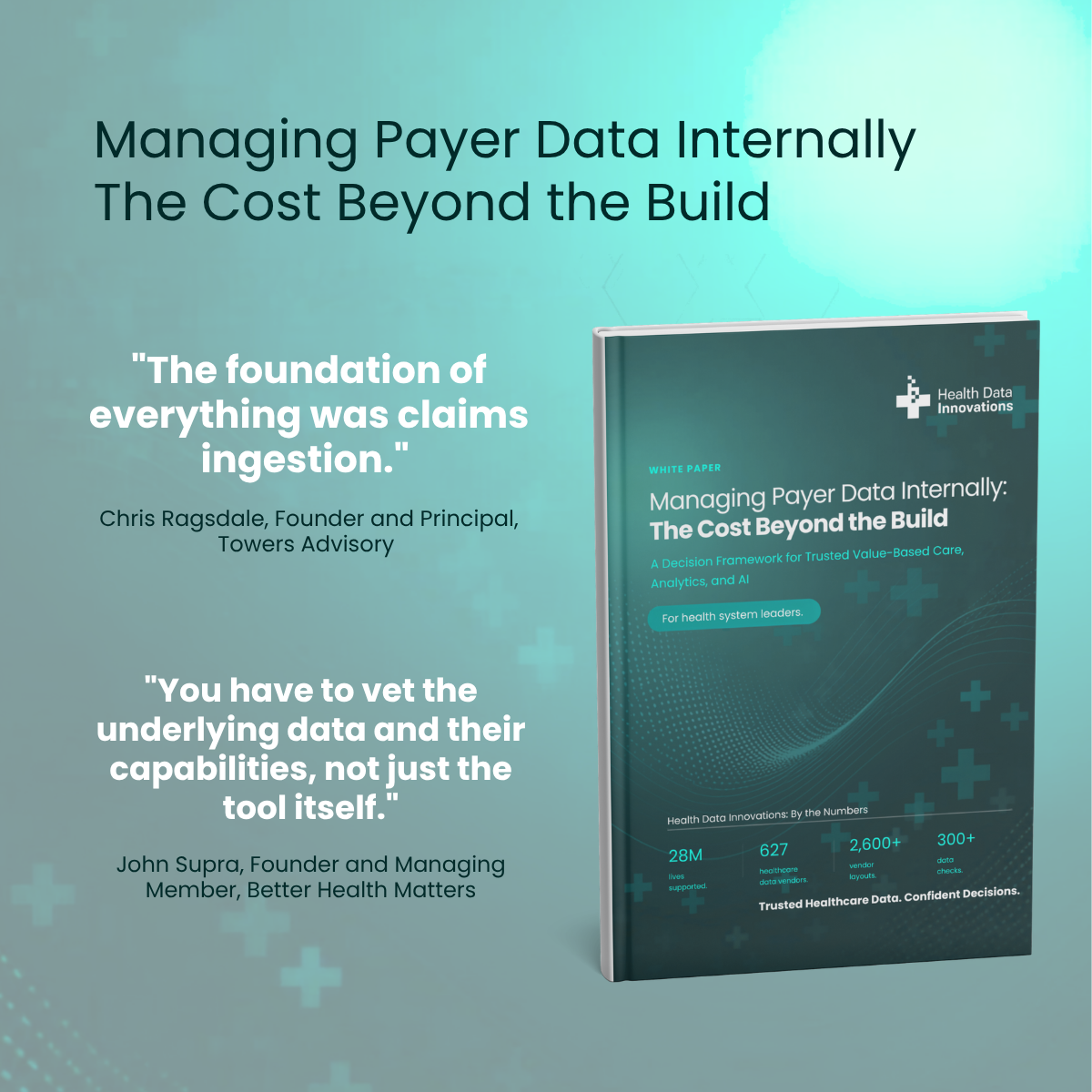
Our new white paper, Managing Payer Data Internally: The Cost Beyond the Build, gives health system leaders a framework for choosing how to best manage payer data. The options are to build and maintain it internally, rely on an analytics platform, or engage an External Data Management specialist. The paper examines the recurring work, hidden costs, and expertise each approach requires.
Why managing payer data matters more every year
According to the Health Care Payment Learning & Action Network, risk-bearing value-based care arrangements now account for 28.5% of payments across all lines of business. In Medicare Advantage, the figure is 43.0%. As this share grows, more of a health system’s financial performance depends on data generated outside its walls.
Claims data shows the care your EHR can’t see – care that happens outside of the system, such as specialist visits, emergency department encounters, filled prescriptions, and labs performed elsewhere.
Payers use the same claims data to calculate utilization, cost, and settlement. A health system without a reliable view of this data ends up with three problems. Care coordinators chase care patients already received. Genuine gaps get missed. Settlements bring surprises.
Small numbers can have large consequences. In one contract, a care coordinator used claims data to close care gaps for just a few more patients. It was enough to reach the 90th percentile benchmark and bring in nearly $1 million in incremental revenue.
“The foundation of everything was claims ingestion.”
Chris Ragsdale, Founder and Principal, Towers Advisory
What the white paper covers
The confidence gap is measurable.
The 2025 HDI Market report found that 87% of health systems said claims data is important to value-based care success, but only 35% were highly confident in its quality and accuracy.
The work starts after the first file arrives.
The paper breaks down the nine recurring responsibilities of payer data management, from missing file detection to claims reconciliation to exception management. A health system with eight payers can receive 40 or more source files a month before a single correction.
Hidden costs rarely show up on one budget line.
One health system reported that a single incorrect relationship code cost $250,000 to unwind. Another estimated 40 to 60 hours of IT work, then waited six to nine months for it to start. The paper includes an illustrative three-year cost model for managing payer data across eight payer contracts.
Expertise is the real risk.
Knowledge of payer layouts and rules tends to concentrate in one or two people. When they leave, the knowledge leaves with them.
You have three options, and the tradeoffs differ.
The paper compares building internally, relying on ingestion within an analytics platform, and engaging an External Data Management specialist. It looks at each across ownership, expertise, scaling, and portability.
One validated foundation changes the outcome.
Integration is not validation. When data is acquired, validated, and resolved once, then delivered to analytics, the EHR, and AI applications, every system works from a Single Source of Truth.
Meet the contributors
Jonathan Kaye, Founder and Executive Chairman, Health Data Innovations. Jonathan has worked with claims data since 1990. Over that time the data flows have stayed largely the same, while the delivery of care and the move away from fee for service have changed a great deal.
John Supra, Founder and Managing Member, Better Health Matters. John’s work spans healthcare data, analytics, and digital health, with experience across health systems, value-based care organizations, and Medicaid. He has seen how technical success can conceal a data failure.
Chris Ragsdale, Founder and Principal, Towers Advisory. Chris is a healthcare strategy and transformation leader with experience across health systems, value-based care, and payer and provider consulting. He has led multiyear value-based care transformations where claims ingestion was the critical dependency.
Get the white paper
Find out what managing payer data is really costing your organization, and whether your current approach can support your value-based care and AI commitments.
Trusted Healthcare Data. Confident Decisions.