
Interactive assessment tool: How to determine what external data operating model fits your organization?

October 19, 2026|

Start Your Readiness Check: Access the External Data Management Interactive Assessment Tool.

Build, platform, or partner isn’t a decision with one right answer. This interactive tool scores your own complexity, control gaps, and internal readiness, then gives you a personalized recommendation.

What’s inside the Interactive Assessment Tool

  • A short set of guided questions that score your complexity, control gaps, and internal readiness as you answer
  • A direct recommendation for your specific environment: whether building internally, using an analytics platform, or working with a specialist partner is the better fit today
  • An RFP blueprint with the exact questions to ask any external data vendor
  • A specific next step so you know what to do with your results

Build, platform, or partner isn’t a one-size-fits-all answer. It’s a decision about your complexity, your controls, and your readiness. Get the version built for your organization.

Start Your Assessment

External data management is the ongoing work of receiving, validating, reconciling, and delivering data from parties outside your four walls – payers, labs, pharmacy benefit managers, and more. Minimum file requirements include medical claims, pharmacy claims, eligibility, but often include attribution, care gap, survey data, EHR data, and other files. It is not a project. It is a permanent operating commitment. With each additional payer or contract, the complexity compounds. This assessment measures three things about your environment:

The rules the assessment follows

  • Middle-of-the-road options. “Partially, with effort” is a real, respected middle option worth 1 point out of 2.
  • Complexity, Control, and Readiness & Urgency are scored independently, then added together. A small, clean, low-urgency system may land low on all three. A large, messy, urgent one will land high on all three.

Once you have your results, you’ll also find “Take it further” – reference material you can reuse in vendor conversations and internal planning:

  • RFP Blueprint – Vendor-evaluation questions to ask any external data partner, with the evidence to request for each.
  • Build, platform, or specialist partner? – A side-by-side comparison of what each operating model actually requires.
  • Why this matters now – The market and technology trends driving this decision.
  • Cost considerations – The categories worth pricing out before you build vs. buy.
  • How this works – The rules, scoring key, and definitions behind your results.
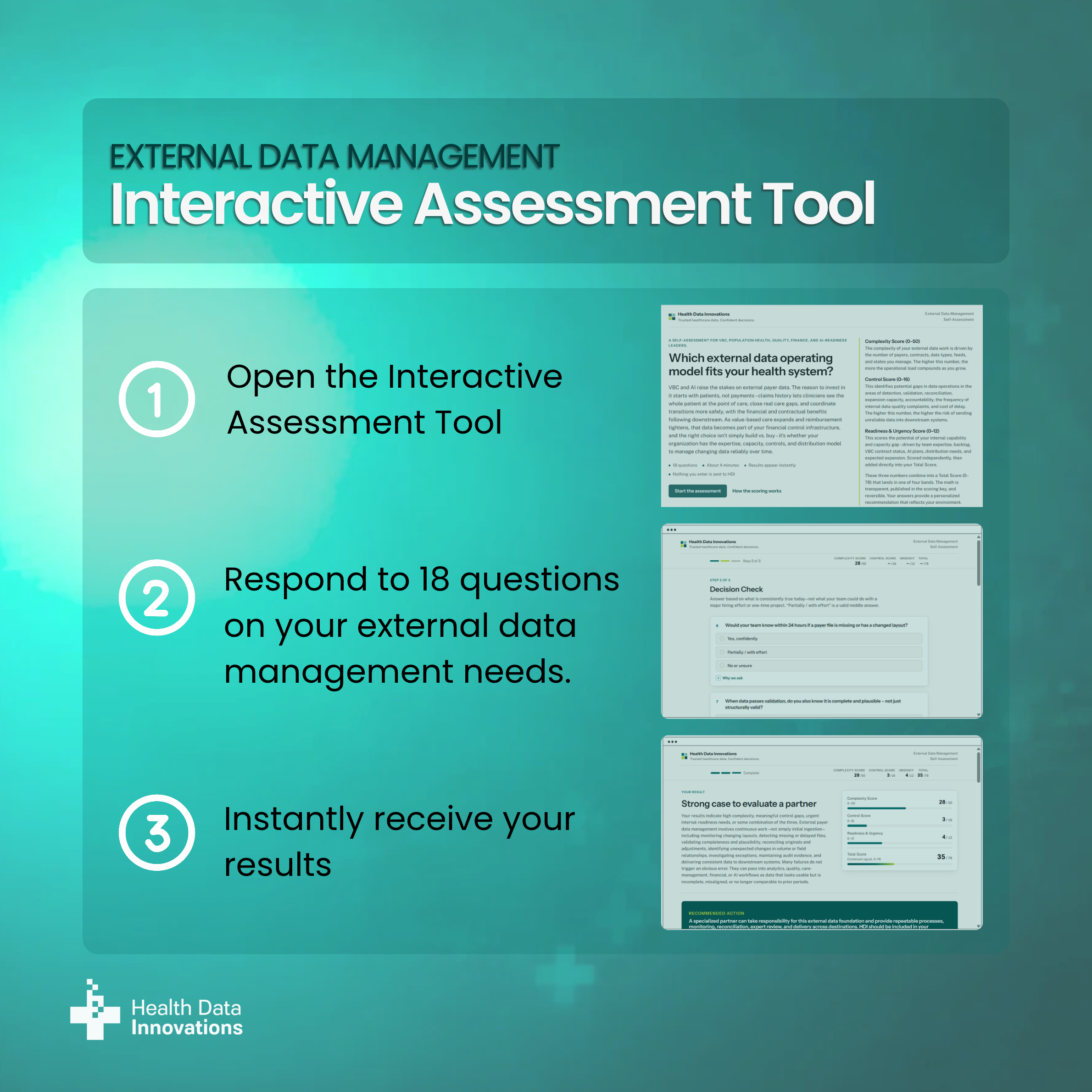
The assessment consists of 18 questions, taking an estimated 4 minutes to complete. Your results appear instantly.
Upon completing the assessment, you will receive a complexity, control and readiness score which will combine for a total overall score.
  • Complexity Score (0–50): The complexity of your external data work is driven by the number of payers, contracts, data types, feeds, and states you manage. The higher this number, the more the operational load compounds as you grow.
  • Control Score (0–16): This identifies potential gaps in data operations in the areas of detection, validation, reconciliation, expansion capacity, accountability, the frequency of internal data-quality complaints, and cost of delay. The higher this number, the higher the risk of sending unreliable data into downstream systems.
  • Readiness & Urgency Score (0–12): This scores the potential of your internal capability and capacity gap – driven by team expertise, backlog, VBC contract status, AI plans, distribution needs, and expected expansion. Scored independently, then added directly into your Total Score.
These three numbers combine into a Total Score (0–78) that lands in one of four bands. The math is transparent, published in the scoring key, and reversible. Your answers provide a personalized recommendation that reflects your environment.