
Human in the Loop Healthcare Data: What AI Readiness Actually Requires
Why automation alone cannot certify data as AI ready
Most healthcare organizations already run some form of automated validation on incoming claims data. Automated checks are necessary but not sufficient. A rule can flag that a field is missing, a code did not match expected structure, or volume dropped unexpectedly for a source. But automation alone cannot determine why. Is a file late, or did it fail to transmit? Did a coding pattern change because of a legitimate update, or because a vendor altered their file layout without notice?
Those are judgment calls, and judgment calls require a person who understands healthcare data and how to identify the root cause of issues before that data moves downstream, not after.
Where human in the loop healthcare data happens
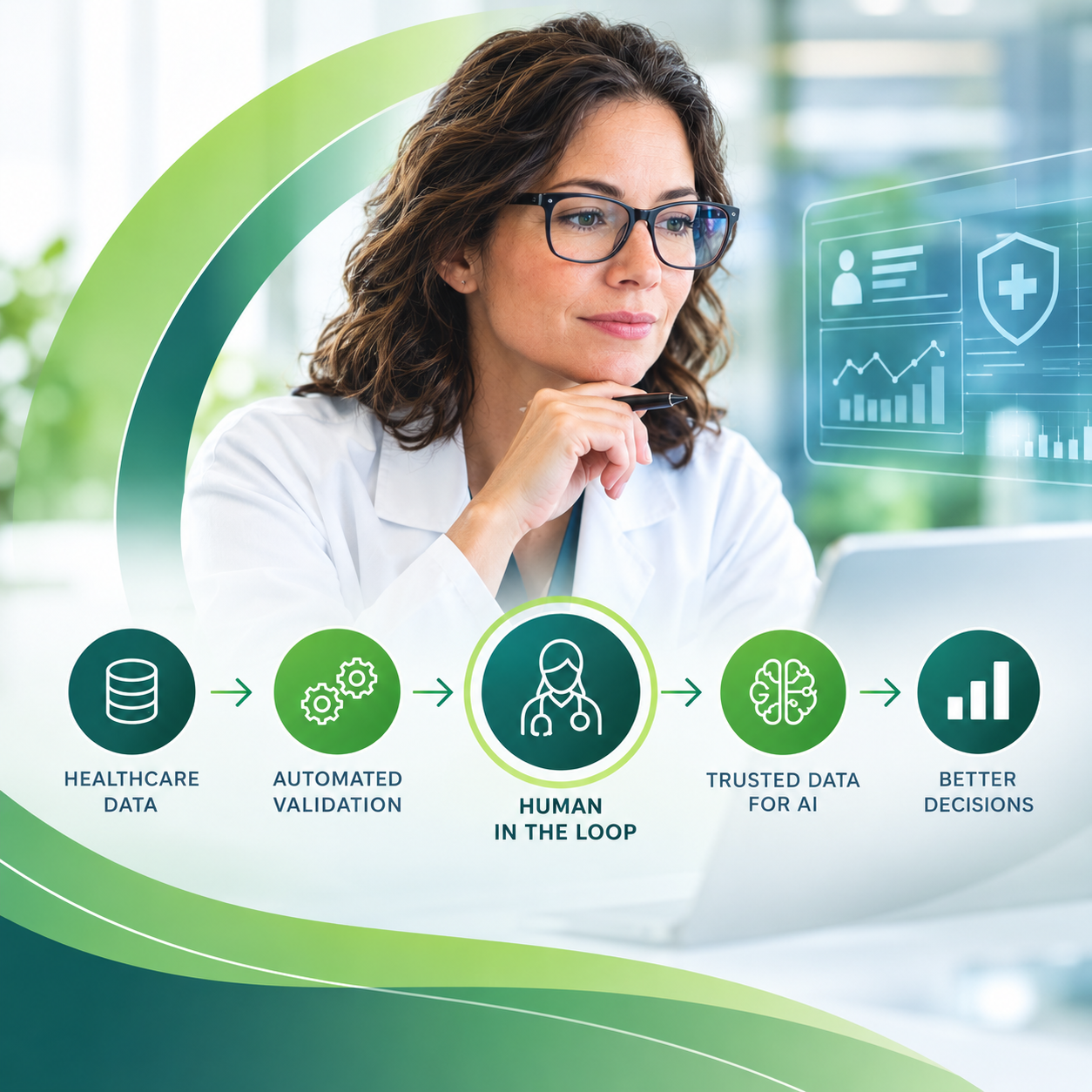
At HDI, human in the loop is not a slogan layered on top of the process. It is the Resolve step of the HDI Data Management Model: Discover, Calibrate, Acquire, Transform, Resolve, Deliver.
During Transform, incoming files are mapped into the HDI Core Data Model and run through a library of more than 300 business rules and validations, everything from confirming standard codes are valid to confirming claims are sequenced correctly so dollars and utilization hold up under scrutiny. When those checks surface an anomaly, the system does not pass the exception along to be loaded into downstream systems. It should initiate an expert review.
This is where Resolve begins. A healthcare data expert investigates the root cause, not just the symptom. They determine where the anomaly originated. This can be incomplete data, the file itself, an improperly formatted code, the file transfer, or various other reasons.
When the issue traces back to the source, HDI documents it with enough detail and specific examples that the payer or vendor can correct it quickly. The system processes corrected data, reconciles results, and validates the data before that it is considered resolved. Nothing moves forward on the assumption that a flag equals a fix.
This is the difference between identifying a problem and resolving it. Technology can surface an anomaly, and a consistent process makes review repeatable. Healthcare data experts must determine what the anomaly means and what should happen next. AI readiness depends on all three working together.
“While there are experts on data in general, they may not be data experts about healthcare data. They may not understand when something is off about a file, where I feel like HDI can see that immediately.” – Manager, Value Based Care, Large Health System
What this looks like at scale
Skeptics of human review usually raise the same objection: “Doesn’t a person in the loop slow everything down?” In practice, experienced reviewers can often recognize anomaly patterns quickly. Deep expertise in healthcare data enables reviewers to quickly investigate the root causse and keep the review from becoming a bottleneck. Human oversight is not a substitute for automation; it is what makes automation more dependable at scale.
The result is reliable data that downstream systems, including AI platforms, can actually build on. Not raw data that has merely passed a checklist, but healthcare data that a person has looked at, understood, and stood behind.
“Since we went with HDI and having their skills and expertise to find things, something that’s beyond what should be the threshold or just not right, they’re kind of working as our early detection system now.” – Executive Director for Analytics, Large Academic Health System
Actual intelligence, before artificial intelligence
AI models are only as good as the judgment applied before they ever see the data. This judgment is not something a validation script can replace, no matter how many rules it runs. It requires actual intelligence, healthcare data expertise applied at the moment an anomaly appears, not discovered later in a dashboard or a flawed prediction.
This is what AI readiness actually requires: not faster ingestion, but a human in the loop who investigates, resolves, and stands behind the data before an algorithm ever touches it. Trusted healthcare data enables confident decisions. The promise does not change when the “decision maker” is an algorithm instead of a person. If anything, it matters more.