
Category: Blog
Category: Blog
Topics:
Topics:
Claims Data Limitations: What Health Systems Can Do About Them
Claims data limitations are well documented. In its guidance for organizations that develop quality measures, the Centers for Medicare & Medicaid Services (CMS) notes that claims data is collected for billing, which limits how well it measures quality. Claims show that a service happened and what it cost, but they often don’t carry the clinical findings many quality measures need, such as whether a patient’s blood pressure was controlled.
Health systems use claims data differently. Claims data is the foundation upon which they manage value-based care. They have clinical data in their own systems, and claims data completes the picture with care members receive outside the health system, pharmacy claims, and what payers paid.
In value-based care, payers calculate total cost of care, utilization, and shared savings from paid claims. That makes claims data one of the most valuable sources a health system has, tied directly to the dollars in risk contracts and settlement.
Realizing the value of claims data depends on how health systems receive and validate the data. Health systems can’t change how claims data arrives, but they can change how their teams, or a partner, validate and prepare it before it is loaded into downstream systems.
That work is External Data Management: acquiring, validating, standardizing, and normalizing data that comes from outside the organization, such as payer claims, so leaders can rely on the data behind their decisions.
What are the limitations of claims data?
The limitations of claims data come from its purpose. CMS states that “the primary purpose of these data is not for quality measurement” and that claims data is “often limited in content, completeness, timeliness, and accuracy” (CMS Measures Management System). Each of those limits applies when health systems use payer claims data for value-based care.
| CMS limitation | What it can mean for health systems |
|---|---|
| Content | Claims show diagnoses, procedures, and costs, but not the clinical findings behind them. The health system’s own clinical data fills in that detail where needed. |
| Completeness | Missing files, fields, or data can go undetected. |
| Timeliness | Claims arrive after the date of service, typically in monthly feeds. Late or missing files can delay the view of recent months. |
| Accuracy | Reliability problems are inherent in claims data and are often tied to how the data is captured, prepared, and loaded. Data loaded into downstream systems without being validated, standardized, and normalized carries those problems with it. |
CMS also recognizes the strengths of claims data: it is “professionally coded using standardized data” and drawn from large populations. Common healthcare data standards provide a starting point, though each payer may interpret them a little differently.
Payers don’t apply those standards consistently, and the standards cover how data is prepared for exchange, not whether it’s validated. That makes it difficult to aggregate data from multiple payers and get it ready claims data integration. These limits add up when a health system receives data from several payers at once. Payer processes and file handoffs also play a part in what makes claims data unreliable or incomplete in the first place.
Why do health systems struggle to use claims data for population health and value-based care?
Health systems struggle to use claims data for population health and value-based care because each payer sends data with its own formats, schedules, and rules, and the limits CMS describes show up differently in each one. Managing population health and value-based care programs depends on seeing the whole member across those sources, and that view takes work before anyone can use the data.
Claims data brings the complete picture of member care, but simply loading data doesn’t validate it, which is part of the data confidence gap many leaders describe.
How do you keep payer claims data reliable over time?
Health systems keep payer claims data reliable and consistent over time by validating each month’s claims data against prior months before loading. Rigorous validation catches changes in volume, members, or payer file layouts. This process enables health systems to identify issues with the data, investigate the issues, and request corrections prior to final transformation and loading.
Practices that keep payer claims data reliable:
- Compare each month to historical data. Sudden shifts in claim counts, member counts, or paid amounts may signal a data problem rather than a change in care.
- Reconcile originals, adjustments, and reversals. Incoming data may change the status of a previously loaded claim. Those claims need to be reconciled for reliable results.
- Confirm each payer’s layout before anyone uses the data. A changed field definition can load without errors and skew results.
- Tie claims to eligibility. Medical and pharmacy claims should match an eligible member for the month of service.
- Account for completeness. Files can arrive with missing data, so a detailed accounting of what arrived, and what didn’t, is important to request the missing data.
- Document issues so your team can request corrected files. For exceptions, claims data experts must identify the root cause and document issues so your team can request corrected files from the payer.
- Reprocess corrected files. The corrected files must be put through the validation and transformation process to verify that the issues have been resolved.
- Monitor throughout the contract term. Reliable data year-round gives leaders time to manage performance throughout the contract term and a better-informed understanding at settlement.
This work takes specialized claims data expertise, which is hard to hire and retain. When the checks fall behind, teams may find problems late, when they are hardest to manage. Worse yet, these issues can emerge after the data has been loaded into downstream systems and analysts find that unreliable data is now impacting their work.
Downstream impact of unreliable claims data:
- Delays performance improvements, including care initiatives
- Makes it hard for teams to work at the top of their license
- Causes users to question the data and spend unnecessary time tracking down data issues
- Reduces return on investments in analytics tools
How do you standardize claims data from multiple payers?
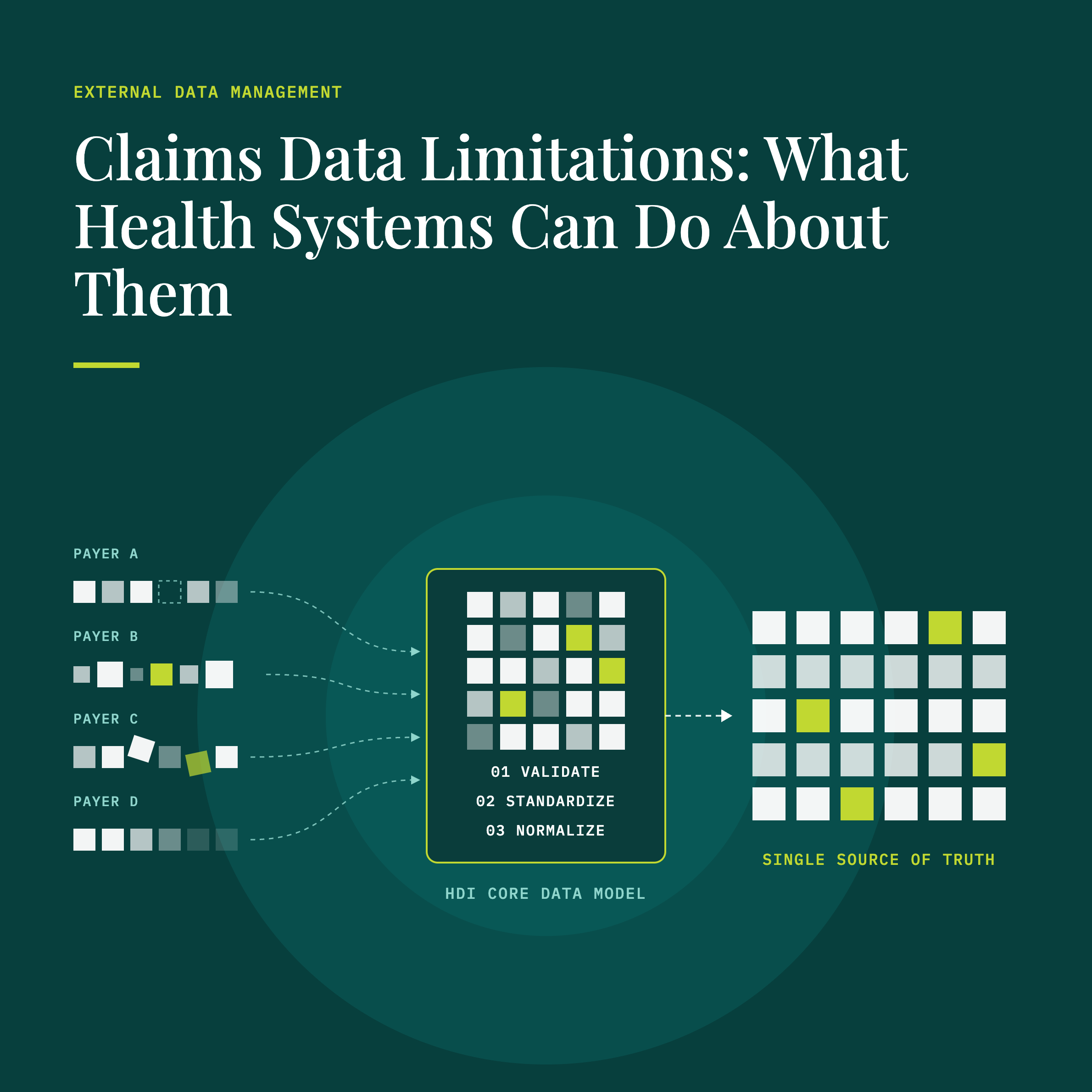
Health systems standardize claims data from multiple payers by giving each payer’s data a common structure so it loads the same way, then normalizing codes and terminology so disparate data speaks the same language. Together, these steps let teams use the data across payers.
Transforming data from multiple payers requires getting all the data to speak the same language, and preparing it for loading into target systems:
- Start with one target data model. Map each payer’s layout to it, so all data can be unified, structured, and transformed using the same model.
- Maintain mappings as payers change layouts. Payers update file layouts, sometimes without notice, and mappings need to keep pace.
- Transform various payer data using one process. Transforming all payer data through one model, with the same transformation logic, makes the data more consistent across sources.
- Normalize codes and descriptions. Member IDs, provider identifiers, place of service, and drug codes and descriptions can vary by payer.
- Prepare extracts for system-specific requirements. Downstream systems have different requirements for incoming data. Once data has been transformed and unified using the same logic, data can be loaded into various target systems with a single source of truth.
Frequently asked questions about claims data limitations
What are the limitations of claims data for value-based care? For value-based care, claims data can arrive incomplete and vary by payer. Those limits can affect population counts, cost trends, and care gaps until teams validate the data and account for anything missing.
How do you make claims data ready for AI and analytics? Teams make claims data ready for AI and analytics by validating, standardizing, and normalizing it before any model or dashboard uses it. AI tools find patterns in whatever data they receive, so AI-ready claims data starts with reliable inputs.
What is the difference between standardization and normalization? Standardization gives data from different payers a common structure, so it loads the same way. Normalization aligns codes and terminology, so the data speaks the same language.
What does HDI do?
Health Data Innovations (HDI) manages the complex work of external healthcare data aggregation and validation. HDI aggregates and validates payer claims data once across all data sets, creating a single source of truth for the departments, teams, and systems that rely on it, from Epic to data warehouses and analytics tools. HDI has worked with 627+ data vendors, and our External Data Management services help health systems work within the limits of claims data.
In HDI’s 2025 market report, only 35% of healthcare leaders said they were highly confident in their claims data quality. Read the 2025 market report to see how health systems view the reliability of their claims data.