
Category: Insights & Reports
Category: Insights & Reports
Topics:
Topics:
Claims Data Quality in Value-based Care: Betting on Questionable Data
Why Value-Based Care’s Biggest Risk Might Be Sitting in Your Own Claims Files
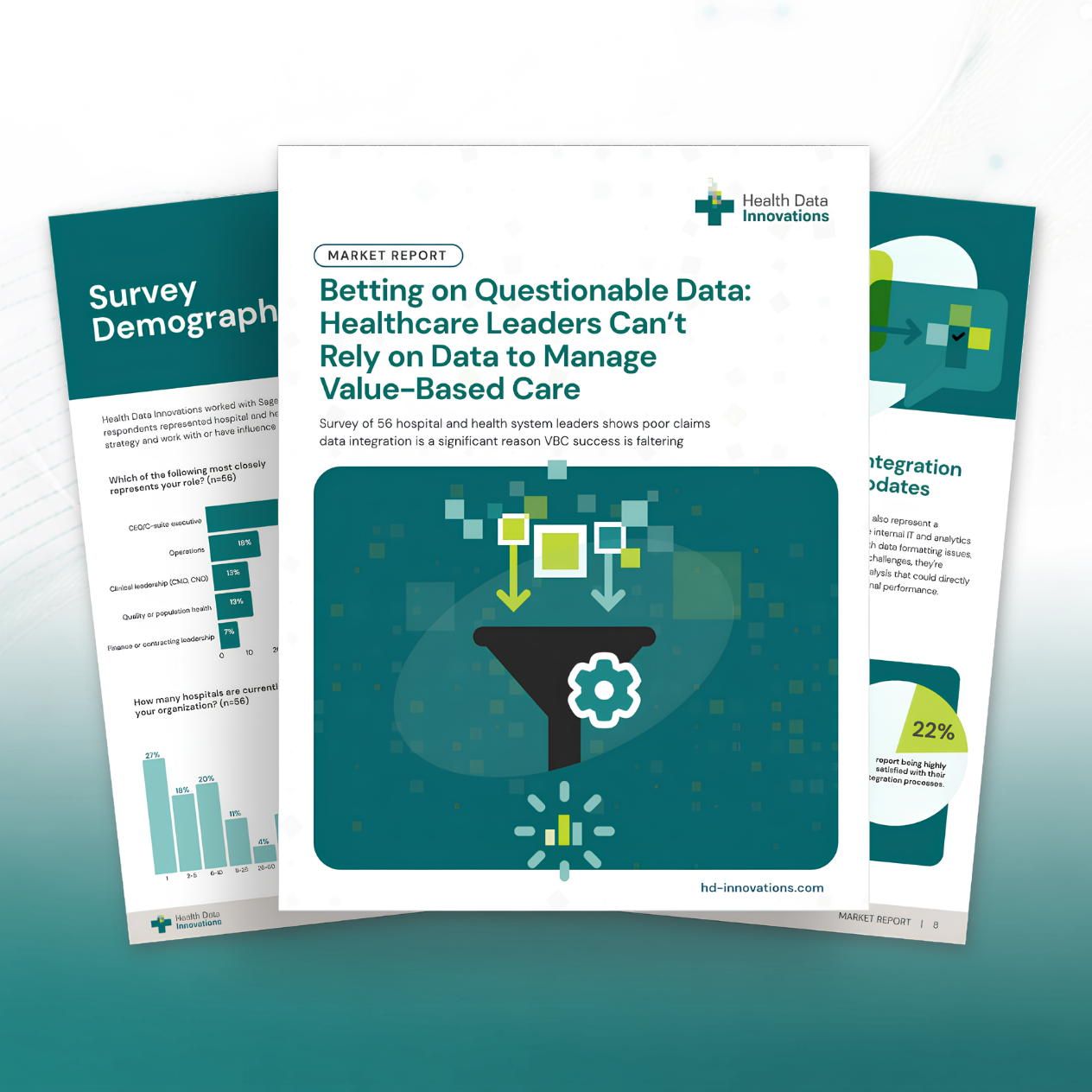
Value-based care has become the default operating model for hospitals and health systems pursuing better outcomes and lower costs. But the 2025 market report from Health Data Innovations suggests that the entire strategy may be resting on a foundation few leaders trust.
A Paradox Hiding in Plain Sight
The research surveyed healthcare leaders with deep knowledge of their organization’s VBC strategy. It uncovers a contradiction. Nearly every executive says claims data is essential to VBC success. However, most don’t believe in the accuracy of the very data driving their decisions. As the report puts it, it’s “akin to navigating a ship with a compass you don’t trust.”
That’s not a minor inconvenience. It means multimillion-dollar contract negotiations, care management investments, and performance strategies rely on numbers that leadership itself questions.
The Numbers Tell a Startling Story
The data paints a picture of near-universal reliance paired with near-universal doubt:
- 87% of healthcare leaders say claims data is critical to VBC success, and 74% say executive leadership depends on it daily
- Yet, only 35% are highly confident in the quality and accuracy of that same claims data
- Just 11% rate their data infrastructure as “excellent,” and a mere 22% report being highly satisfied with their current integration process
In other words, nearly two-thirds of organizations are making critical VBC decisions on data they fundamentally question.
The Hidden Complexity Behind Every Claims File
The report breaks the root causes into three categories:
- Structural challenges like payer file layouts that shift without warning
- Temporal challenges like inconsistent delivery timelines
- Substantive challenges like the sheer difficulty of correctly sequencing and summarizing claims.
More than three in four leaders describe the integration effort as ‘somewhat’ to ‘extremely’ challenging. Nearly half say onboarding a new payer’s data takes five months or longer.
That’s five months where market conditions shift, attributed populations change, and windows for intervention quietly close.
This is the operational core of what HDI calls External Data Management. It is the ongoing work of discovering, calibrating, acquiring, transforming, resolving, and delivering external data so leaders can trust it.
The Real Cost Isn’t Just Unreliable Data: It’s Lost Time
Perhaps the most striking insight isn’t about accuracy at all. It’s about opportunity cost. File formatting, validation, and cleanup consume data and analytics teams’ time. That means they’re not doing the higher-value work that could move VBC performance forward. One hospital CEO summed up the frustration bluntly: “The integration between EHR and payer data has been too difficult.”
AI Raises the Stakes
This challenge is only becoming more urgent. Healthcare organizations are racing to adopt AI for claims processing, population health, and performance analytics. AI doesn’t fix broken data. It scales it. Feeding unreliable claims data into AI models doesn’t produce better insights. It produces faulty decisions at greater speed and scale, magnifying the very confidence crisis this report uncovers.
 What separates organizations stuck in this cycle from those pulling ahead? The report identifies specific capabilities that top-performing health systems are using to close the confidence gap. It also outlines what the rest of the industry must do to catch up before the competitive window closes.
Get the Full Picture
This survey-backed report goes deeper into what’s really undermining VBC data accuracy. It covers what healthcare leaders say they need to fix it. And it shows who stands to gain a lasting data-driven advantage in the years ahead.