
Category: Blog
Category: Blog
Topics:
Topics:
AI Ready Claims Data: Why Claims Infrastructure Will Decide Who Wins
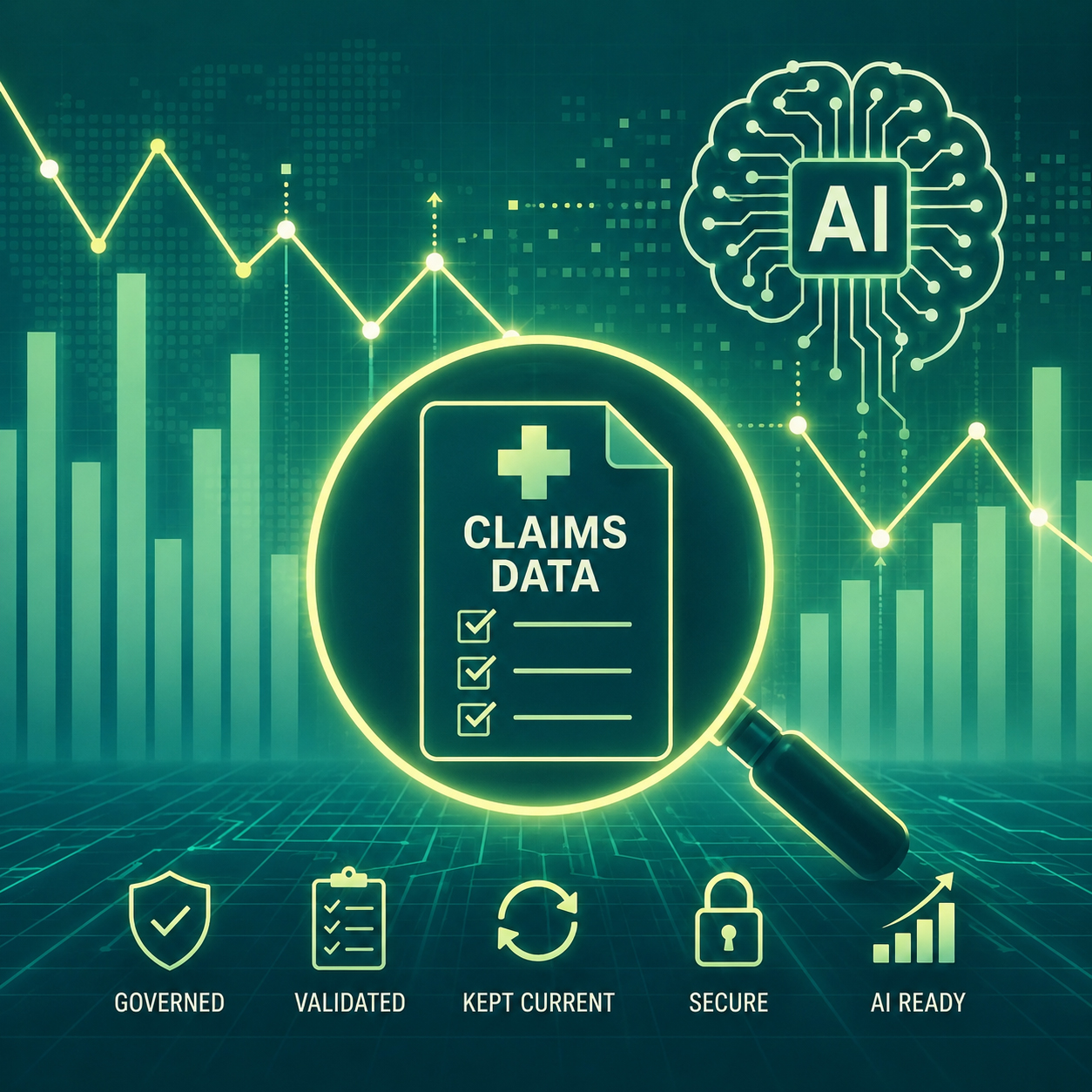
Health systems are moving quickly to use AI across value-based care and population health. Yet, much of the ambition around AI still depends on claims data that was never engineered for AI scale decision-making. The gap between AI expectations and data reality is becoming a strategic risk in healthcare. Closing that gap starts with claims data that is truly AI ready: governed, validated, and kept current before a model ever sees it.
The complexity and variation of claims data creates challenges for AI
Claims integration can look simple: collect files from major payers, load them, and let analytics or AI utilize the data. In practice, claims files use different layouts, codes, timing conventions, and file rules. There is no universal standard, and payers have limited incentive to harmonize.
The complexity compounds as contracts and payer relationships grow. In addition to common challenges of claims data, undetected changes or misinterpreted data context can ripple through warehouses and analytics platforms before anyone notices. When AI models are trained or deployed on top of that variability, they learn from a moving target instead of stable, governed data.
How data defects shape value-based care and AI outcomes
Claims data is the connective tissue of value-based care. It captures what happens to patients outside a provider’s own walls and underpins settlement, quality, and utilization measures. Even modest, undetected shifts in population mix, patterns, or utilization can distort risk adjustment and financial projections.
When AI is layered onto that same data—whether for forecasting, risk stratification, or contract analytics—it inherits any inaccuracies baked into the claims data.
The AI ambition-data reality gap
Across industries, surveys consistently show a disconnect between AI ambition and data utilization reality. Executives often believe their data is AI ready. Meanwhile, practitioners and data leaders identify data quality and availability as the biggest barriers to AI adoption. In healthcare, poor data quality and weak integration are repeatedly cited as major reasons AI models fail to earn operational trust.
Data quality defects scale with AI. For example, an issue that once affected a single encounter can become a repeated pattern once it enters a training set or production workflow. Reviews of AI in health insurance and healthcare similarly emphasize concerns around transparency, reliability, bias, and accountability when AI systems are built on incomplete or low-quality data.
Governance and claims expertise as AI enablers
Organizations that consistently realize value from AI treat claims data readiness—as a governed, specialized discipline rather than a background IT function. Healthcare AI discussions indicate that thoughtful aggregation, clear access rules, and accountable stewardship are central to trustworthy AI, particularly when models draw on insurance and claims data. Data quality experts make a similar case, linking stronger claims data management to more reliable and usable outputs.
Claims expertise is a specialized, scarce resource in most health systems. Often, only a small group of professionals work directly with external claims data and may not experience enough variation to readily understand payer-specific conventions, changing file layouts, and cross-system reconciliation requirements. That work is a distinct operational specialty, not an occasional project. When that expertise is embedded in a strong governance framework—including standards, ingestion validation, and transparent quality metrics—it becomes an AI infrastructure enabler rather than a bottleneck.
Turning claims data into AI ready infrastructure
If AI is going to sit at the center of value-based care, risk analytics, and operational optimization, then claims data infrastructure effectively becomes AI infrastructure. Organizations that invest in continuous validation and formalize claims data governance will be better positioned to deploy AI with confidence. Their models will learn from more complete, reliable, and well-understood inputs.
HDI’s purpose-built technology, proven processes, and hands-on healthcare data experts work as one integrated capability to keep claims data AI ready long before it reaches a model. Every incoming file is tracked. HDI applies more than 300 business rules, validations, and operational checks before data reaches a downstream system. Experts review exceptions for investigation and resolution. That capability spans 627 healthcare data vendors and 2,600+ vendor layouts, and reflects 16+ years focused exclusively on healthcare data. HDI provides health systems with a stronger foundation to support AI, analytics, and value-based care with confidence.
The strategic question is no longer whether to use AI. It is whether the claims foundation can support the kinds of AI an organization wants to deploy. Organizations that treat claims data infrastructure as a strategic AI asset will be better positioned to turn AI investment into durable value instead of short-lived pilots. Trusted, AI ready claims data is what turns that foundation into confident decisions across value-based care, analytics, and every AI initiative built on top of it.